Questions for ‘Fast, mysterious clouds swarm around our galaxy’ 
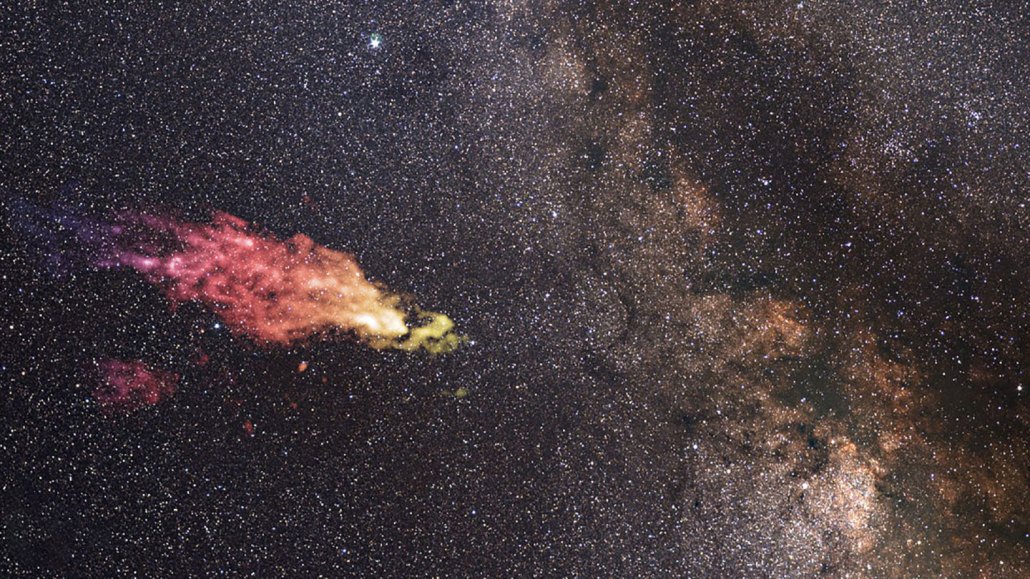
a composite image showing Smith's Cloud and the Milky Way

This composite image shows Smith’s Cloud (reddish, left of center) moving toward the Milky Way. (The image of the Milky Way is a false-color photograph where different colors correspond to radio signals.) One 2016 study found that some 5 million years ago a similar cosmic cloud may have punched a hole in the Milky Way’s disk.

NASA/ESA/Levay/STScI, Saxton/Lockman/NRAO/AUI/NSF/Mellinger

To accompany Fast, mysterious clouds swarm around our galaxy

SCIENCE

Before Reading:

  1. What do you think fills the space between different galaxies? Use what you already know to speculate on objects or matter that might lie between galaxies.
  2. What might the study of matter or objects lying between galaxies — rather than inside them — tell us about the universe? Give one example of a question that the study of such matter or objects might help us answer.

During Reading:

  1. What is the main element in Smith’s Cloud?
  2. Compared to the stars of the Milky Way galaxy, what is unusual about the direction of travel of Smith’s Cloud?
  3. What does HVC stand for?
  4. Describe two theories about where HVCs come from.
  5. What year was the first HVC discovered?
  6. Some scientists propose that HVCs might serve as a “galactic fuel supply.” Describe one piece of evidence that — if found — would support this theory.
  7. What about Smith’s Cloud makes some astronomers believe it formed from a close encounter with a dwarf galaxy rather than through the “galactic fountain” process?
  8. Why does Naomi McClure-Griffiths say that the name “Magellanic Clouds” is misleading?
  9. What property, or characteristic, of the Magellanic Stream is McClure-Griffiths investigating?
  10. Describe one characteristic of HVCs that makes it hard to determine how far away they are.
  11. What is unusual about the center of the HVC known as AC-I?

After Reading:

  1. One theory described in this story is that HVCs operate like “galactic fountains.” Point to one piece of evidence from the story supporting the idea that Smith’s Cloud originated via this process. Draw a comic strip with at least three panels showing how HVCs would work as per this theory. Include a short one-sentence explanation for each scene. Reference the role of gravity at least once in your explanations.
  2. McClure-Griffiths says one thing she thinks is “lovely about science” is that “people put out theories and nobody finds evidence.” The theory falls out of favor until, later, someone finds evidence that “opens people’s minds again.” Give one specific example of this occurring in this story. What does this say about the value of being open-minded in science? If scientists could not keep an open mind about theories, what problem would they encounter?