All Stories
- Earth
Plastic trash rides ocean currents to the Arctic
Ocean currents can carry plastic trash far from the cities that shed it. Some plastic debris has made it all of the way to the Arctic Ocean, new data show.
- Microbes
Tweaked germs glow to pinpoint buried landmines
Finding landmines could become much safer with a new technology. It uses genetically modified bacteria that glow under laser light.
- Life
Scientists Say: Mitochondrion
Mitochondria are structures inside cells that converts certain chemicals into adenosine triphosphate — a molecule cells use as energy.
- Tech
Teens garner some $4 million in prizes at 2017 Intel ISEF
Hundreds of teens collectively took home about $4 million in awards from the Intel International Science and Engineering Fair this week.
- Materials Science
A better way to stop a bullet?
A teen researcher's tests suggest that fabric body armor might stop bullets better if it were woven using a three-fiber, triangular mesh instead of the typical two-fiber-mesh configuration.
- Health & Medicine
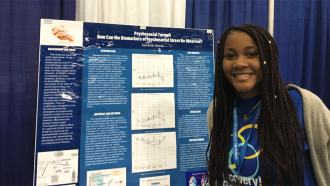
Teens take on science in the age of smartphones
With nearly every teen using a smartphone, it’s no surprise teen scientists are studying them. Two teams do science with smartphones, one on procrastination, the other on self-esteem.
- Earth
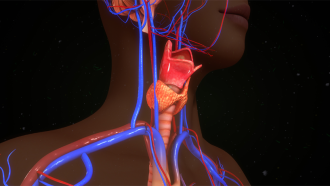
Some food-packaging pollutants mess with the thyroid
Chemical pollutants may hurt the ability of the thyroid gland to make an important hormone. Teens may be most at risk.
- Agriculture
Sheep poop may spread poisonous weed
Fireweed is a poisonous plant in Australia. Sheep can eat it without hurting themselves. But a teen found those sheep may be spreading more weeds.
- Oceans
Teen’s invention can warn of deadly rip currents
A teen lifeguard from Australia has invented a buoy that can alert swimmers to the strong, swift and deadly rip currents that can sweep them dangerously far offshore.
- Physics
After 30 years, this supernova is still sharing secrets
It’s been 30 years since astronomers first witnessed the stellar explosion known as SN 1987A. Today, researchers are still learning from this cataclysmic phenomenon.
- Health & Medicine
Library books could come with a side of germs
People transfer microbes to most of the things we touch. Does that extend to our library books? A teen did an experiment to find out.
- Science & Society
Research is important because…
Teens wouldn’t do science unless they felt it was important. Here’s why they think it matters so much.