All Stories
- Physics
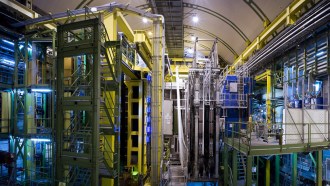
New particle may help probe strongest force in the universe
A newfound subatomic particle should allow scientists to better understand the strong force that holds together the nucleus of every atom.
-
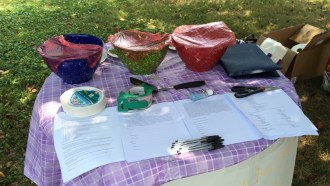
Cookie Science 8: The meaning of the mean
I have had people eat cookies and fill out surveys. What do I do with all those numbers? First I have to find something called the arithmetic mean.
- Animals
Ancient jellyfish died a strange death
Scientists have probed the fossilized remains of an ancient jellyfish. It reveals a bizarre sequence of events that led to its preservation 310 million years ago.
- Planets
Comet probe may shed light on Earth’s past
Scientists spent more than two decades setting up Philae’s months-long investigation of a comet. What they hope to learn could shed light on Earth’s childhood — and the source of its water. But that’s if problems with Philae’s landing don’t cut the robot’s life span.
- Animals
When life exploded
Life exploded in diversity during the Cambrian Period. Experts are exploring what could account for this sudden change 540 million years ago.
- Planets
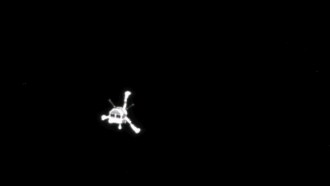
Picture This: Falling to a comet
After a more than decade-long ride, a robotic lander has left its spacecraft and floated down onto the surface of a comet. From there it should begin scouting for hints at how our solar system formed.
- Climate
World leaders call for action on climate change
This week, the presidents of China and the United States pledged to take aggressive action on the release of greenhouse gases to head off dire worldwide climate effects.
- Animals
New frog discovered in New York City
This animal could almost be mistaken for the southern leopard frog — until it opens its mouth. The call the males issue has proven unique.
- Physics
Detecting a single proton
Doctors typically use magnetic-resonance imaging, or MRI, to see tissues and organs inside the body. Physicists can harness a similar technology. And they did that to spotlight something even smaller — a single proton. But followup analyses, reported in January 2015, forced a retraction of their original claim.
- Genetics
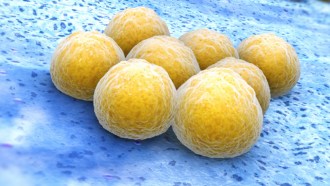
Germs help each other fend off antibiotics
Drug-resistant bacteria can cause persistent infections. A new study finds these germs fight drugs in different ways. And they can swap various compounds, increasing their neighbors’ chances of overcoming the drugs meant to kill them.
- Physics
Raindrops break the speed limit
Raindrops shouldn't be able fall faster than what is known as their terminal velocity. But no one told the rain. Researchers have found droplets breaking that speed limit.
-
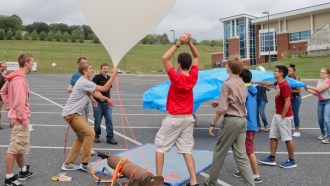
Teachers launch weather balloons, and a passion for science
Making science hands-on can help inspire students and show how interdisciplinary research can be. Here, two teachers share their experiences working with a high-altitude research-balloon kit.