Let’s learn about how particles act like waves
‘Wave-particle duality’ is one of the weirdest things about quantum physics
The building blocks of our universe don’t just act as pointlike particles; they also ripple through space like waves.
agsandrew/Getty Images
The smallest stuff in our universe acts in a lot of strange ways. Quantum physics is the field of science that tries to wrestle with this weirdness. And one of the weirdest features of the quantum realm is that every particle of light or matter can also act like a wave.
Scientists call this phenomenon wave-particle duality. The term applies to elementary particles such as electrons and photons — the most basic building blocks of our universe. Bigger clumps of matter, such as atoms and molecules, also display this feature, as does antimatter.
Each of these things can act like a particle, moving through space like a baseball thrown over a pond. But they can also travel through space like a wave rippling across that pond.
This might sound impossible. But scientists have seen wave-particle duality in action. One famous lab test showing this strange phenomenon is the double slit experiment.
Imagine a barrier that has two slits in it. Facing the barrier is a device that fires out electrons. Behind the barrier is a screen that catches the electrons that pass through the slits. Now, turn your electron-firing device on.
If electrons only acted like particles, they should land in two distinct clusters on the screen behind the barrier, one behind each slit. But that’s not what happens. Instead, the electrons build up in a series of stripes on the screen.
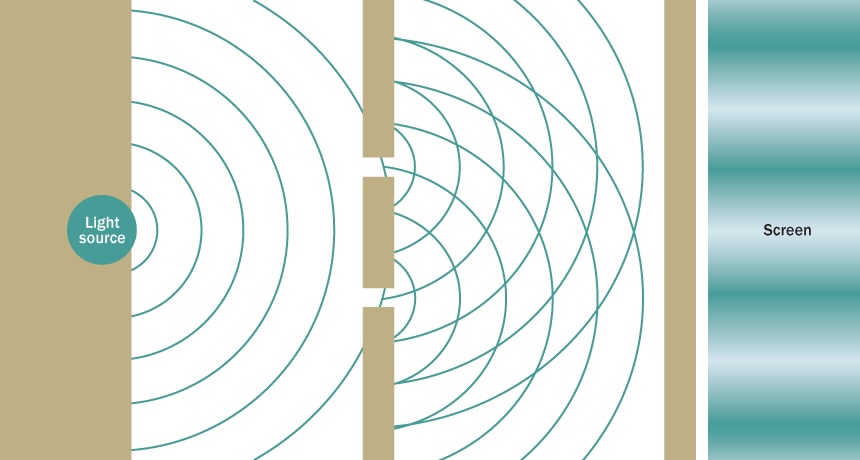
This type of “interference pattern” appears when two waves overlap and “interfere” with each other. The electrons pass through the slits as waves and interfere with each other on their way to the screen. As the two waves merge, their crests and troughs reinforce each other in some places and cancel each other out in others. This gives rise to the stripes.
Double-slit strangeness
E. Otwell
Graham Beards/Wikimedia Commons (CC BY-SA 4.0)
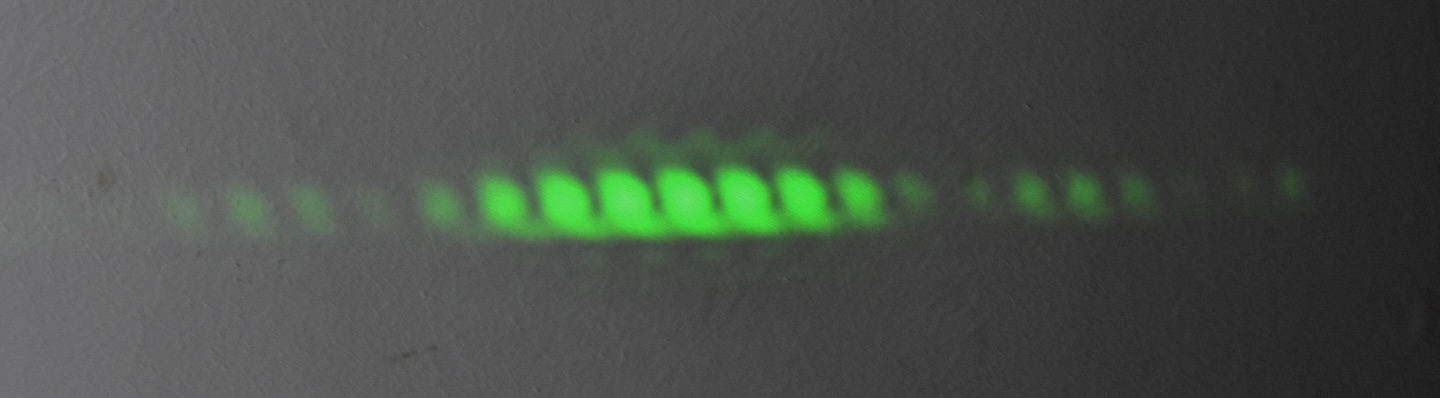
The top diagram shows what happens when you pass light particles through two slits in a wall. The particles act like waves, crossing over each other as they emerge from both slits. This creates an “interference” pattern of alternating light and dark bands on the screen behind the slits. The photo on the bottom shows what a screen looks like when you send the light particles from a green laser through a pair of slits.
But it gets stranger still.
Now, imagine you put a sensor next to each slit. The sensor will detect whenever an electron passes through that slit. When you again turn on your electron-firing device, each electron passes through one slit or the other like a particle. The electrons pile up in two distinct clusters on the screen behind the barrier. The interference pattern is gone.
Changing how you observe the particles seems to change how the particles behave. In the first case, where you don’t observe the individual slits, the electrons act like waves. But when you observe the slits, the electrons act as particles. This is a truly head-scratching paradox.
Want to know more? We’ve got some stories to get you started:
Trying to break a photon would create a quantum mess The fact that light particles can also act like waves recently raised a curious question — what would happen if you snipped a light wave in half? (7/9/2026) Readability: 7.0
Here’s why scientists want a good quantum computer The discovery that particles of light and matter also act like waves was a milestone in quantum physics. (5/30/2024) Readability: 7.9
A new device uses atoms’ quantum weirdness to peer underground This device harnesses wave-particle duality to measure gravity. (3/30/2022) Readability: 7.6
Explore more
Let’s learn about the quantum realm
Let’s learn about entanglement
The quantum world is mind-bogglingly weird
Physicists have clocked the shortest time span ever
Antimatter keeps with quantum theory. It’s both particle and wave (from Science News)
Activities
Want to see how the double-slit experiment works in action? The Perimeter Institute has several interactive simulations to help.
In the first simulation, you can see what would happen if you launched tennis balls at a pair of gaps in a wall. The pattern that builds up on the other side is what you would expect to see, if bits of matter such as electrons and atoms only acted like particles.
Then, try the simulator that shows what would happen if you passed waves of water through a pair of gaps in a wall. The pattern that builds up on the other side is what you’d expect to see from things that travel through space like waves.
Then, try the double slit experiment using light and with electrons. What types of patterns build up on the other side of the gaps? Do those patterns match what you’d expect to see from tennis ball–like particles, or from waterlike waves?