Nuclear clocks are nearly here
This brand-new type of clock would be the most precise timepiece ever

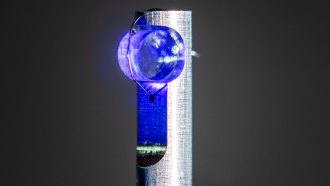
Physicists are trying to build a brand-new type of clock (shown in this artist’s illustration). Called a nuclear clock, it would be based on the physics of atoms’ hearts — and keep time better than today’s most precise clocks.
TU Wien
Nuclear clocks could be the GOAT: Greatest of all timepieces. If physicists can build them, nuclear clocks would be a brand-new type. These clocks would keep time based on the physics of atoms’ hearts.
Some scientists believe the first of these could debut in a few years.
At the center of each atom is a nucleus. That’s where protons and neutrons are found. Clocks based on atomic nuclei could be 10 times as precise as today’s most exact clocks.
Better clocks could improve technologies such as GPS navigation. But “it’s not just about timekeeping,” physicist Peter Thirolf said June 3. Nuclear clocks could allow new tests of fundamental ideas in physics. Thirolf works at Ludwig-Maximilians-Universität München in Germany. He spoke at an online meeting of the American Physical Society.
Currently, the most precise clocks are atomic clocks. They aren’t based on the nucleus. They tally time using the energy jumps of electrons. Electrons in atoms can carry only certain amounts of energy, in specific energy levels. To bump electrons in an atom from one energy level to another, the clock’s atoms must be hit with a laser. And the laser’s light must be just right.
Light is made up of electromagnetic waves. Frequency is the rate at which those waves pass by. Only light of a certain frequency will make the electrons jump. That frequency serves as a highly precise timekeeper. Imagine using the rate at which waves wash up on a beach to keep track of time. But in this case, they’re light waves.
Protons and neutrons within an atom’s nucleus also occupy energy levels. Nuclear clocks would rely on jumps of those particles instead of electrons.
Adriana Pálffy is a theoretical physicist. She works at Friedrich-Alexander-Universität Erlangen-Nürnberg in Germany. An atom’s nucleus isn’t as affected by stray electric or magnetic fields as the atom’s electrons are. She says that suggests nuclear clocks “would be more stable and more accurate.”
But there’s a problem. Typical lasers can’t access nuclear-energy levels. For most nuclei, that would require higher energy light than normal lasers can achieve.
How excited
Luckily, there’s one lone exception. “A freak-of-nature thing,” Marianna Safronova said in a June 2 talk at the meeting. She is a theoretical physicist at the University of Delaware in Newark.
The exception is thorium. Thorium is a metallic chemical element. There is a variety of the element known as thorium-229. It has a pair of nuclear energy levels that are close together. The energy levels are so close, in fact, that a laser might be able to set off the jump.
Scientists recently pinpointed how much energy a thorium-229 nucleus needs to make the jump. This is a crucial step toward building a thorium nuclear clock.
Thirolf and his colleagues estimated the energy by measuring electrons that the nucleus emitted when it jumped between levels. The team described its findings in Nature two years ago.
Another team took a different approach. It measured the energy of other jumps the thorium nucleus can make and subtracted them. Those researchers reported their findings in Physical Review Letters last year.
Both teams agree that thorium-229’s nucleus takes about 8 electron volts to jump energy levels. This energy corresponds to the edge of lasers’ power. That suggests lasers might be able to prompt a jump.
Making the jump
Physicists now are aiming to trigger that jump with lasers.
Chuankun Zhang is a physicist at JILA, a research institute in Boulder, Colo. At the meeting, Zhang reported efforts to use a frequency comb. A frequency comb is a laser with an array of light frequencies. The comb will hopefully let Zhang’s team spur the nucleus to jump. It also could let the team better measure the energy needed to make the jump. “If it’s a success,” Zhang said, “we can directly build a nuclear-based optical clock from that.”
Thirolf’s team also is working with frequency combs. His team aims to create a working nuclear clock within the next five years.
Meanwhile, Pálffy is looking into using what’s called an “electronic bridge.” Rather than using a laser to hit an atom’s nucleus directly, the laser would first excite the atom’s electrons. Those excited electrons would then transfer energy to the nucleus. Pálffy presented this idea at the meeting.
Test of time
Nuclear clocks could let researchers devise new tests of fundamental constants of nature. A fundamental constant is a number that never changes. At least we think it doesn’t ever change. Tests with nuclear clocks would help scientists figure out if the numbers are in fact constant, or if they vary over time.
Nuclear clocks could also test a foundation of Einstein’s gravity theory — the equivalence principle. It states that two different objects in a vacuum should fall at the same rate.
This new type of clock might even aid in the search for dark matter. Dark matter is invisible. It’s made of particles that scientists have yet to detect. Physicists think these particles account for most of the universe’s matter. If dark matter were to interact with a nuclear clock, the interaction could tweak the clock’s ticking.