Dormant microbes from Ötzi the Iceman’s body can grow in the lab
The cold-loving yeasts may be thousands of years old
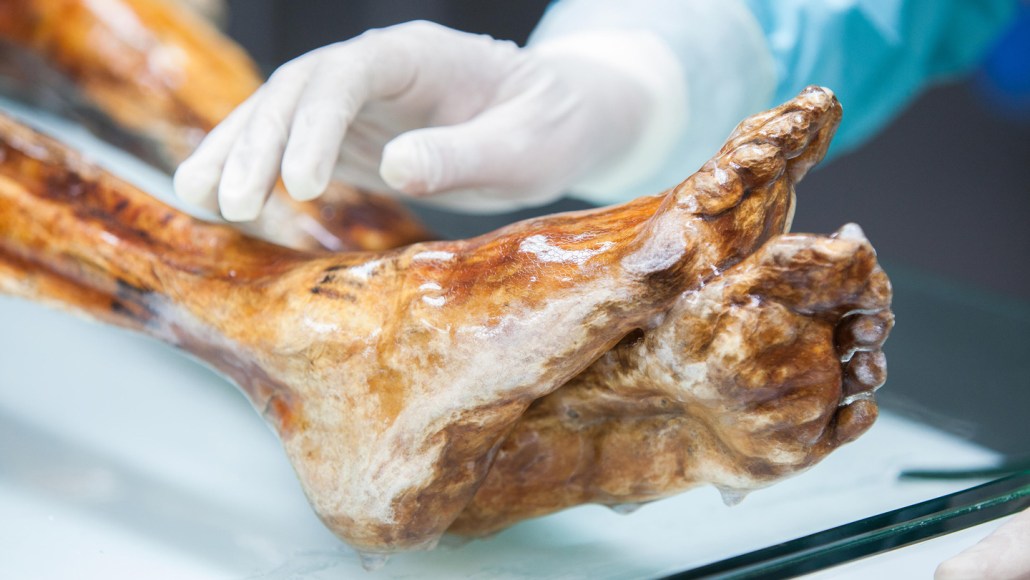
Microbes might still grow on Ötzi’s carefully chilled body. This finding could help scientists protect the mummy from being decomposed.
Marion Lafogler/ Eurac Research/South Tyrol Museum of Archaeology
This is a human-written story voiced by AI. Got feedback? Take our survey . (See our AI policy here .)
For a long time, scientists considered Ötzi the Iceman a messenger from the Copper Age. But new research shows this frozen mummy wasn’t alone. He hosts small companions — dormant, cold-adapted yeasts. In other words, his remains might not be as frozen in time as researchers once thought.
Since Ötzi’s discovery in the Italian Alps in 1991, his body has been housed in a specialized facility in Bolzano, Italy. Scientists there held his remains at –6° Celsius (21.2° Fahrenheit). This has been to keep his body from degrading. It’s a temp close to that of the glacier in which he’d been found.
Four ancient species of yeast have now been found in his remains. And they’re still able to grow in the lab, reports Albert Zink. His team isolated “ancient DNA from these species,” he notes. An anthropologist, until recently, he worked at the Eurac research center in Bolzano, Italy. (He’s now at Ludwig Maximilian University of Munich, in Germany.)
Those DNA show the yeast “accompanied [Ötzi] over thousands of years while he was preserved in the ice,” Zink says.
Scientists suspect Ötzi thawed and refroze several times — especially in the first 1,500 years after his death. That could help explain why his remains still host microbes.
Zink’s team shared its results on June 3 in Microbiome.
Do you have a science question? We can help!
Submit your question here, and we might answer it an upcoming issue of Science News Explores
Frozen in time?
Researchers thawed Ötzi’s body to 4 °C (39.2 °F) for five hours. Then, they collected the liquid that melted off his remains. They also swabbed parts of Ötzi’s body and took samples of his skin and other tissues.
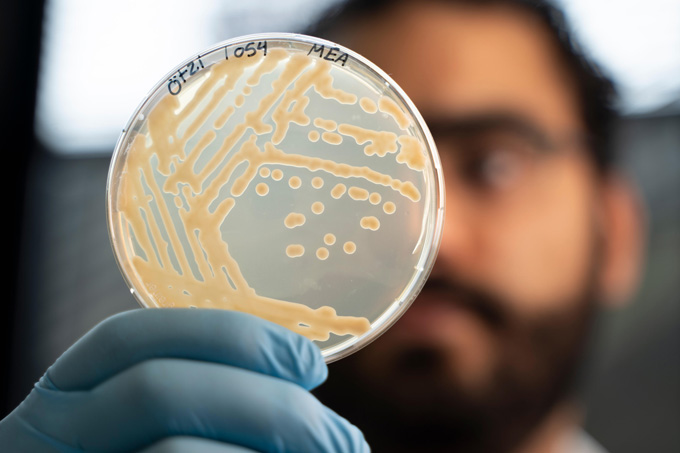
Four colonies of yeast grew from these samples. Scientists compared these yeasts to those in soil near the glacier where Ötzi was found. They also checked air and the water that the museum had used to keep the mummy’s chamber humid.
These tests showed those four yeast species really came from the mummy. They were effectively time capsules of Ötzi’s time in the ice after his death. Bacteria were also extracted from internal tissues. None of these grew in the lab.
The new findings suggest the iceman’s remains seem to still be interacting with the environment.
Risks to the mummy
Those microbes could pose a problem. If they don’t stay dormant, they could end up decomposing the mummy.
This conclusion is “right on the mark,” says Patrick Hunt. He’s an alpine archaeologist at Stanford University in California who did not take part in the new study.
Ötzi is “the most important archaeological-science finding of the 20th century,” Hunt says.
Ötzi’s mummy has offered an incredible window into the man’s former life. From many studies, scientists know he wore leather clothes, had multiple tattoos and would have likely gone bald. Past work even shows he ate a high-fat meal before he died and carried an ax made of copper derived from far away.
More such discoveries may emerge only if Ötzi’s body remains preserved. That requires getting to know the cold-loving and potentially damaging microbes on his body. It also makes the new findings essential, Hunt says. They’ll help scientists preserve this iceman for the ages.