Questions for ‘Meet the world’s biggest waves — and the mysteries behind them’
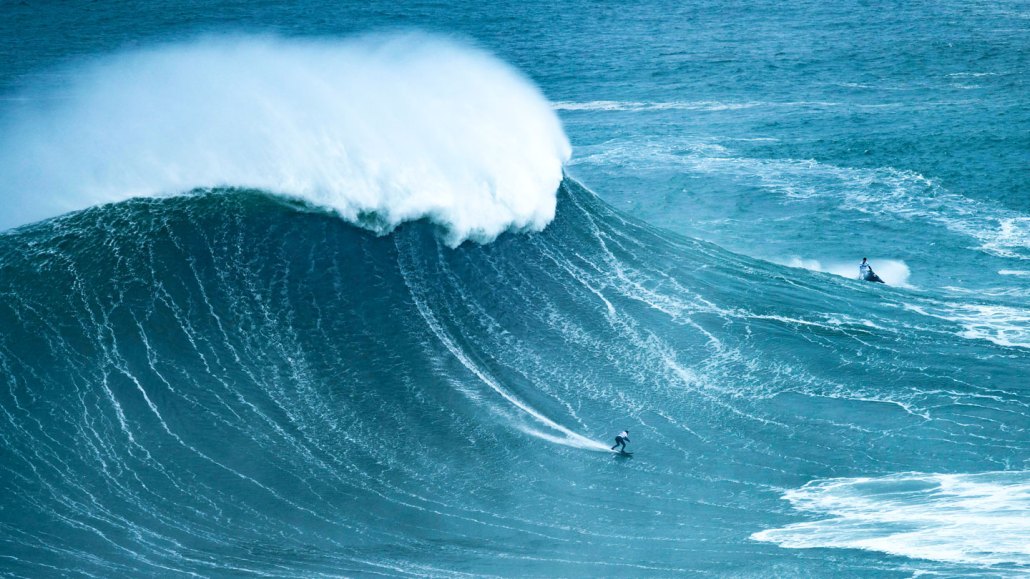
Here, off the coast of Nazaré, Portugal, on October 29, 2020, Sebastian Steudtner set a record for the tallest wave ever surfed. That wave was 26.21 meters (85.99 feet) tall.
SOPA Images Limited/Alamy
Share this:
- Share via email (Opens in new window) Email
- Share on Facebook (Opens in new window) Facebook
- Share on X (Opens in new window) X
- Share on Pinterest (Opens in new window) Pinterest
- Share on Reddit (Opens in new window) Reddit
- Share to Google Classroom (Opens in new window) Google Classroom
- Print (Opens in new window) Print
To accompany ‘Meet the world’s biggest waves — and the mysteries behind them’
SCIENCE
Before Reading:
- List two factors — such as geological changes, weather effects or other events — that you think can trigger waves in an ocean, lake or other body of water.
- Imagine a coastline with a river emptying into an ocean. Create a fictional map of this imaginary region. Use an arrow to show the direction of water flow from the river. Then, sketch waves onto your map. Focus on the direction that you believe those waves would be moving and the overall pattern that they would form when viewed from above. Briefly explain how you imagine these wave patterns would play out. (Your answer need not be completely accurate. Just make sure that your prediction takes into account the fact that two bodies of water are meeting and ensure that your explanation aligns with your illustration.)
During Reading:
- By how many meters did surfer Sebastian Steudtner break the previous record for tallest wave ridden?
- Explain why “sneaker waves” can pose danger to people onshore.
- How does an internal wave differ from a surface wave?
- How tall, in meters, was the largest ocean wave ever recorded? What geological event triggered the formation of this giant wave?
- How do oceanographers define “rogue waves”?
- In the context of waves, what is constructive interference?
- When the S. A. Agulhas II departed port in 2018, which continent was the destination?
- How does the terrain of the Southern Hemisphere contribute to higher intensity storms there compared with the Northern Hemisphere?
- What type of information about waves did buoys designed by Miguel Onorato’s colleagues collect? In what way were they inspired by human vision?
- What is one way that Tori Tomiczek hopes her work will help people?
After Reading:
- Reflect on the meaning of “constructive interference” from this story. What do you think destructive interference would mean in the context of wave science? Explain how you arrived at your answer.
- List three types of dangerous waves, besides rogue waves, that this story describes. Draw a picture depicting each type as though you were illustrating for a textbook. For each picture, write a simple caption that points out one distinguishing trait of this type of wave.
- Reflect on the definition of “rogue waves” as given in this story. Then, pick one of the three wave types you described in Question 2. To what extent might your chosen wave type be considered an example of a rogue wave? Explain how it does or does not meet the definition.