From Molecules to Organisms: Structures and Processes
- Animals
Whales get a second life as deep-sea buffets
When a whale dies and sinks to the seafloor, it becomes a feast for hundreds of different types of creatures.
- Humans
You should guess answers to your homework before searching online
Over a span of 11 years, an increasing share of students performed more poorly on exams than on their homework. Online homework help may explain why.
- Animals
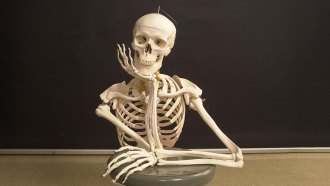
Let’s learn about bones
Bones hold us up and help us fight gravity with every step. They also make blood cells, hormones and more.
- Brain
Confidence can make you miss important information
Being confident can feed a confirmation bias in us, new studies show. This bias can make your brain ignore other people’s ideas and any conflicting information.
- Health & Medicine
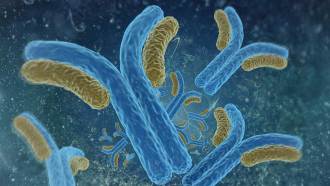
A glowing new way to measure antibodies
Researchers invent a way to detect and measure antibodies with glowing proteins. Antibodies can mark exposure to various diseases.
-
A dirty and growing problem: Too few toilets
As the famous book says, everybody poops. That’s 7.8 billion people, worldwide. For the 2.4 billion with no toilet, the process can be complicated.
- Animals
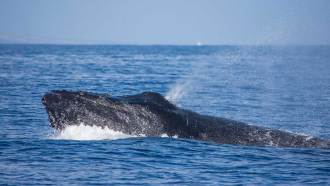
Whale blowholes don’t keep out seawater
Whales’ blowholes aren’t as protective as scientists had thought. They not only can let in water but also pollutants.
- Life
If bacteria stick together, they can survive for years in space
Tiny clumps of bacteria can survive at least three years in outer space. This raises the prospect of interplanetary travel by microbial life.
- Ecosystems
‘Vampire’ parasite challenges the definition of a plant
Langsdorffia are stripped down to their essentials. Lacking green leaves for photosynthesis, they steal energy and nutrients from other plants.
- Animals
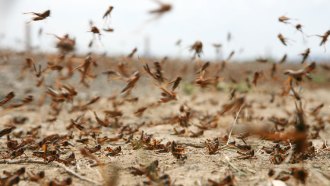
A single chemical may draw lonely locusts into a hungry swarm
Swarms of locusts can destroy crops. Scientists have discovered a chemical that might make locusts come together in huge hungry swarms.
- Animals
Are coyotes moving into your neighborhood?
How do coyotes survive in New York City, Los Angeles and Chicago? Researchers and citizen scientists are working together to find answers.
- Microbes
Some deep-seafloor microbes still alive after 100 million years!
Some starving microbes nap while awaiting their next meal. For some living miles below the ocean surface, that nap may exceed 100 million years.