HS-ESS1-3
Communicate scientific ideas about the way stars, over their life cycle, produce elements.
- Physics
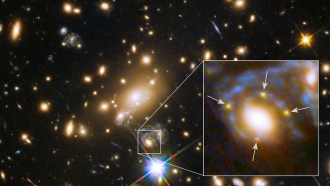
Galaxy cluster creates ‘magnifying glass’ in space
A massive galaxy’s gravity is so strong that it bends light, creating a “lens” in space. This natural magnifying glass is giving astronomers a rare view of a supernova on the other side of the universe.
- Physics
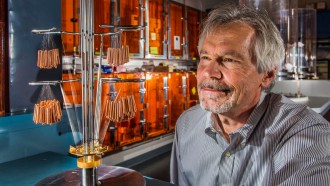
Machine simulates the sun’s core
A machine heats iron atoms to temperatures that match the interior of the sun. This has helped solve a solar mystery.
- Physics
Light robs galaxy of star-making gas
Stars form from clouds of hydrogen and other gases. Astronomers have found the light from newborn stars can drive off that gas. That action can starve a galaxy of the ingredients needed to make more stars.
- Animals
When life exploded
Life exploded in diversity during the Cambrian Period. Experts are exploring what could account for this sudden change 540 million years ago.
- Space
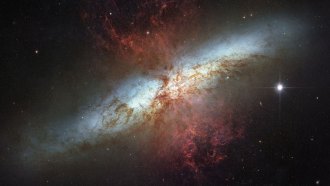
Monster collision in space
The smashup of four clusters of galaxies has sent a super-hot jet of charged particles spewing 2.5 million light-years into space!
- Space
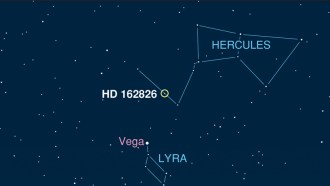
Sun sibling spotted
Separated at birth: Astronomers find a star 110 light-years away. It was born at the same time as our sun and from the same cloud of gas and dust.
- Planets
Heavenly research
Groundbreaking research in astronomy landed four high school seniors spots as finalists in the 2014 Intel Science Talent Search.
- Animals
We are stardust
Everything making up Earth and what’s now living upon it — from trees and people to our pets and their fleas — owes their origins to the elements forged by ancient stars.
- Physics
Closing in on fusion energy
Scientists blasted a tiny capsule of hydrogen with laser beams, setting off a reaction that released more energy than in earlier experiments. Still, scientists remain a long way from creating a reaction that releases more energy than it needs to get started.
-
-
-