MS-ESS1-4
Construct a scientific explanation based on evidence from rock strata for how the geologic time scale is used to organize Earth's 4.6-billion-year-old history.
- Planets
The InSight lander has caught a large ‘earthquake’ on Mars
This magnitude 5 quake is offering scientists a peek at what’s going on beneath the Martian surface.
- Earth
Tiny gemstones show when Earth’s crust first started moving
Chemical hints observed in zircons suggest when the important process of plate tectonics first took off.
- Physics
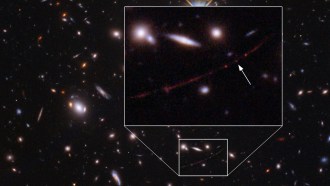
A star called ‘Earendel’ could be the most distant ever seen
A thin red arc found in an image from the Hubble Space Telescope shows starlight from nearly 13 billion years ago.
- Animals
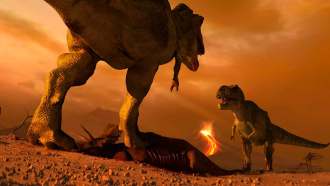
The end of the dinosaurs appears to have come in springtime
Fish fossils from North Dakota suggest when the Chicxulub asteroid devastated Earth, triggering the mass extinction of dinosaurs and other species.
- Physics
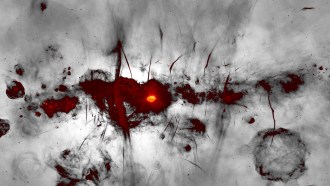
Wild art? No, it’s a radio image of the heart of our Milky Way
Eyelash-like radio filaments accent the brightest feature in this image — a supermassive black hole.
- Planets
The long-awaited James Webb Space Telescope has a big to-do list
The James Webb Space Telescope has been in the works for so long that new fields of science have emerged for it to study.
- Physics
Explainer: Telescopes see light — and sometimes ancient history
Different kinds of telescopes on Earth and in space help us to see all wavelengths of light. Some can even peer billions of years back in time.
- Animals
Explainer: The age of dinosaurs
Take a trip back to the Mesozoic Era to explore how geologic events, ecosystems and evolution were connected during the so-called age of dinosaurs.
- Planets
NASA’s Perseverance rover grabbed its first Martian rocks
Two finger-sized pieces of stone drilled from a basalt rock are the first bits of Mars ready to be brought to Earth.
- Earth
Scientists Say: Anthropocene
Humans are changing the world in profound ways. Some scientists think those changes have launched a new epoch in Earth’s history: the Anthropocene.
- Animals
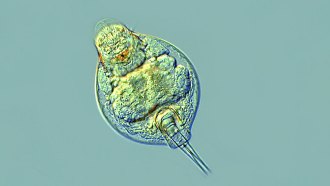
Tiny animals survive 24,000 years in suspended animation
Tiny bdelloid rotifers awake from a 24,000-year slumber when freed from the Arctic permafrost.
- Space
Cosmic filaments may have the biggest spin in outer space
These rotating threads of dark matter and galaxies stretch millions of light-years. Scientists want to know how their spin begins.