MS-PS4-3
Integrate qualitative scientific and technical information to support the claim that digitized signals (sent as wave pulses) are a more reliable way to encode and transmit information.
- Computing
Scientists Say: Artificial intelligence
Artificial intelligence is technology smart enough to do tasks that would normally require human brainpower.
- Tech
Will the internet soon reach the one-third of people without it?
Access to the internet is a human right, yet much of the world can’t get online. New tech has to be affordable and usable to end this digital divide.
- Tech
A tool as small as a human cell can scan for contaminants and more
Tiny spectrometers might someday show up on smart devices. They could help people scan for ingredients or contaminants in foods and other materials.
- Physics
Let’s learn about music
Researchers are delving into how instruments and spaces shape our experience of music, and how computers could play a role in the future of music-making.
- Science & Society
A new audio system confuses smart devices that try to eavesdrop
It works by playing soft, calculated sounds to help people protect their privacy from automatic speech-recognition systems.
- Climate
Coastal cities around the world are sinking, satellite data show
Of 99 coastal cities studied, nearly one-third are sinking. This leaves coastal communities increasingly vulnerable to rising seas.
- Physics
Scientists Say: Doppler effect
The Doppler effect is a perceived change in the frequency of light or sound waves due to the wave source moving relative to an observer.
- Physics
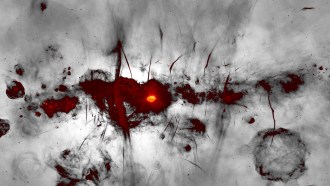
Wild art? No, it’s a radio image of the heart of our Milky Way
Eyelash-like radio filaments accent the brightest feature in this image — a supermassive black hole.
- Planets
The long-awaited James Webb Space Telescope has a big to-do list
The James Webb Space Telescope has been in the works for so long that new fields of science have emerged for it to study.
- Brain
A sense of touch could upgrade virtual reality, prosthetics and more
Scientists and engineers are trying to add touch to online shopping, virtual doctor appointments and artificial limbs.
- Tech
Let’s learn about artificial intelligence
Computers are getting smarter all the time. At some tasks, they can even outsmart people.
- Tech
Headphones or earmuffs could replace needles in some disease testing
A new system that uses earmuffs to collect gases coming out the skin could help doctors diagnose a variety of diseases, scientists say.