All Stories
- Brain
Noticing mistakes boosts learning
People who pay attention to their mistakes are more likely to do better the next time, data show.
- Space
Cosmic mystery: Why are many galaxies dark?
Dark galaxies went unnoticed until 2015. Since then, scientists have now found more than 1,000 — and there may be many, many more.
- Animals
Among mice, scratching is catching — as in contagious
Contagious itching spreads by sight, mouse-to-mouse. Scientists have now identified brain structures behind this phenomenon.
- Chemistry
Scientists Say: Atomic number
How do you know where an element sits in the periodic table? Count its protons to get its atomic number.
- Health & Medicine
Early birds eat better
People who love mornings tend to eat healthier food throughout the day. This could help explain why night owls tend be less healthy overall.
- Psychology
Cool Jobs: Doing real science in virtual worlds
Virtual reality isn’t just for gamers. Scientists are using VR technology to tackle real-world problems.
- Health & Medicine
Legalizing pot may confuse teens into thinking it’s safe
A growing number of teens think marijuana is no big deal, a new study finds. And that may encourage many to experiment with its use.
- Earth
How Earth got its moon
How did our moon form? Scientists are still debating the answer. It may be the result of some one big impact with Earth — or perhaps many small ones.
- Life
Fleets of flying robots could pollinate crops
Tiny flying drones use patches of sticky hair to capture pollen. One day they might join bees in pollinating crops.
- Plants
Scientists Say: Guttation
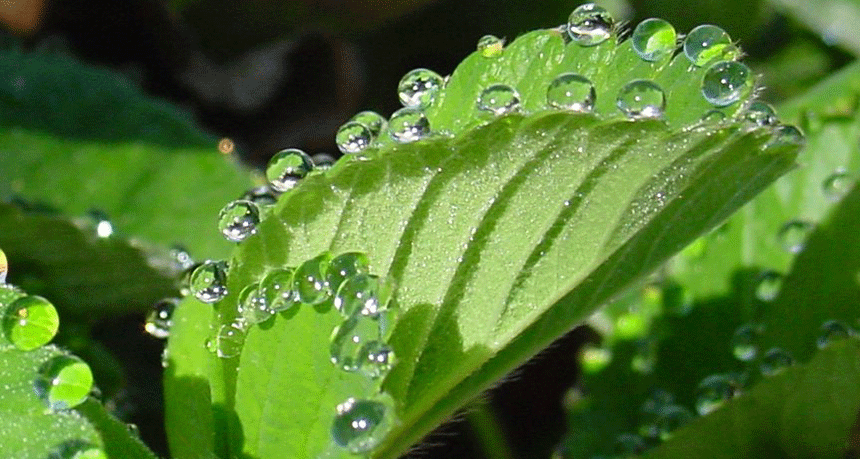
When water vapor can’t escape a plant, it might force its way out through a process called guttation.
- Computing
Single atoms become teensy data storage devices
Most people consider a thumb drive to be an amazingly small device for storing data. But this new system uses a ten-thousandth the number of atoms of today’s data-storage devices.
- Ecosystems
Cities drive animals and plants to evolve
Biologists are finding that some species have used genetic changes to evolve — adapt — to the pollution and other stressors that they encounter in cities.