All Stories
- Climate
Arctic sends weird weather south
Arctic warming is affecting weather farther south, where most of the world lives. The impacts are especially worrisome for agriculture.
-
Kids win $1,000 in clean energy challenge
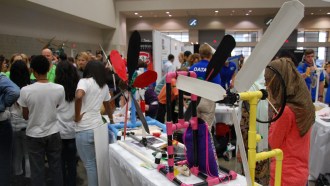
KidWind held its first national competition. The kid’s turbines generated enough power to light an LED bulb.
- Physics
Student radiation experiment goes to space
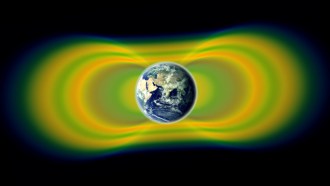
The Exploration Design Challenge asked students to design shields that would protect astronauts from radiation. Teachers can still involve classes in the challenge.
- Health & Medicine
Infected cutting boards
Germs can hitchhike into the kitchen on meat and many types of produce. A new study finds that some of those germs are particularly nasty. They are immune to the one or more of the drugs doctors would prescribe to wipe out the infection.
- Animals
These insects thirst for tears
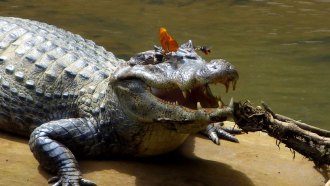
In some parts of the world, insects will drop by for a savory beverage. Interestingly, neither a croc — nor a scientist who offered his eyes up to ‘tear-sipping’ bees — seemed bothered much by the freeloaders.
- Space
Failed ‘star’ found in sun’s backyard
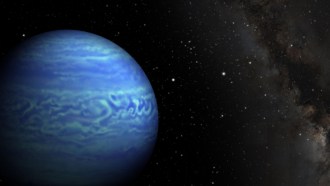
Astronomers have identified a failed star — or brown dwarf — right in our sun’s backyard. It doesn’t burn brightly. In fact, it doesn’t burn at all, which explains its downright frosty temperature.
- Physics
Quark quartet forms exotic particle
Quarks are important building blocks of matter, usually bound together as pairs or triples. Now some have formed a quartet. Scientists confirmed the existence of a particle made of four quarks stuck together. Such strange stuff may have been more common in the earliest universe, the scientists say.
- Environment
‘Greener’ energy needed now, group warns
To avoid a looming environmental crisis brought on by global warming, people need to rely more on renewable energy sources. And fast. Without quick action, the world may face a harsh future, warns the latest report from the Intergovernmental Panel on Climate Change.
- Brain
Ghosts in your head
Many people see, feel and hear things that aren’t really there — despite how much their brain tries to convince them otherwise.
-
Museum showcases healthcare beyond the bedside
Chicago’s International Museum of Surgical Sciences has a new exhibit that displays a cross-section of alternative jobs in medicine.
- Health & Medicine
New ‘Heartland’ disease emerges in U.S. Midwest
A new viral disease causes major pain and flu-like symptoms. At present, no treatment or cure exists.
- Science & Society
FDA announces plans to regulate e-cigarettes and more
The Food and Drug Administration announced it will use its powers to try to keep e-cigarettes, hookahs and cigars out of the hands of minors.