All Stories
- Physics
World’s coolest ‘clock’ is also crazy-accurate
This is the time to beat — the world’s most accurate atomic clock ever. At its heart is a ‘fountain’ of cesium atoms chilled nearly to absolute zero!
- Physics
Explainer: How lasers make ‘optical molasses’
Light can bump an atom. Bump it from several different directions at once and even a fast-moving atom will instantly freeze its motion — and chill it to a temperature of nearly absolute zero.
-
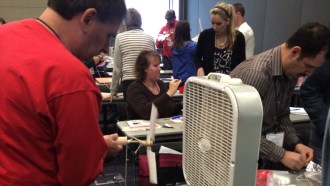
Teaching clean energy with the power of wind
A build-your-own wind energy machine can be a fun and inexpensive way to practice engineering and discover the power of wind.
- Microbes
A success for designer life
Synthetic biologists are scientists who create custom organisms in the lab. Their efforts have just taken a big step forward. They have created the first lab-made yeast chromosome. The advance could lead to entirely synthetic organisms customized to produce food, fuel or medicine.
- Physics
Sending student science to space
Two teachers describe how they worked with the Student Spaceflight Experiments Program to get middle-school scientists excited about research and space.
- Physics
Filter lets in only the right light
Scientists have built a light filter that only permits light coming from one desired angle to pass through. Built from alternating layers of transparent materials, it could help minimize the glare in telescopes and cameras or boost the efficiency of solar cells.
- Animals
Sea otters picked up swine flu
A new study finds that large numbers of sea otters off of the U.S. Pacific coast have been exposed to the ‘pandemic’ type of this killer virus.
-
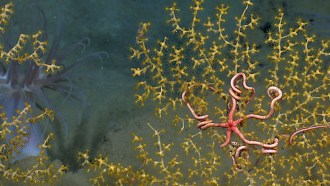
NOAA takes the Internet on a deep-sea tour
From April 12 to 30, the U.S. government is offering free live video and educational materials to explore the Gulf of Mexico’s deep realm.
-
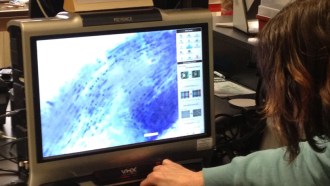
Brewing a cup of chemistry
Andrew West and Aaron Sickel wanted to help teachers combine engineering and chemistry in the classroom. They developed an experimental approach using the power of coffee.
- Space
A ‘wedding ring’ in space
An unusually circular gas remnant of a dead star appears behind a star that’s still burning bright. When viewed from Earth, the pair resembles a sparkling diamond ring.
-
Students compete to stop cyber crime
The Air Force Association’s yearly CyberPatriot competition trains middle and high school students to defeat cyber bad guys trying to get in to their computer systems.
- Animals
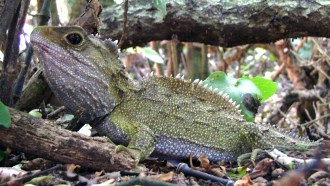
When a species can’t stand the heat
When temperatures rise, New Zealand’s tuatara produce more males. With global warming, that could leave the ancient reptile species with too few females to avoid going extinct.