All Stories
- Animals
Horned lizards and snakes tend to ambush their prey
The reptiles’ horns could help or hinder during foraging, depending on how they hunt. This might be why horns evolved in some species and not others.
- Animals
Pikmin’s plant-animal mashups don’t exist — but sun-powered animals do
Corals team up with photosynthetic zooxanthellae. Some sea slugs steal chloroplasts. How might animals and plants team up in Nintendo’s Pikmin games?
- Life
Scientists Say: Ichnology
This field of science looks to understand life — past and present — by studying how organisms altered their surroundings.
- Climate
Chemists make device to destroy planet-warming methane pollution
It can slash diffuse sources of this extremely potent greenhouse gas, such as from livestock barns and other sites.
- Archaeology
Iron Age grave in England points to a possible woman warrior
The grave holds a sword. It hints the buried woman fought or helped plan raids some 2,000 years ago in what’s now southwest England.
- Tech
Synthetic biology aims to tackle disease and give cells superpowers
DNA machines and protein-mimicking nanotech could replace broken machinery in cells or even lead to made-from-scratch synthetic life.
- Climate
Warmer seas trigger skyrocketing ice loss in 3 Antarctic glaciers
Destabilized by waves and vanishing sea ice, one of the glaciers lost 25 kilometers (15.5 miles) of ice in 16 months — a possible hint of worse to come.
- Tech
Let’s learn about the benefits of playing video games
Too much screentime poses health risks, but research suggests playing video games can sharpen some skillsets.
- Animals
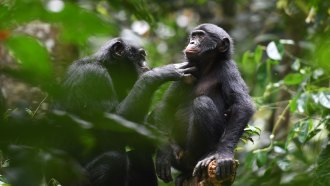
Bonobos cooperate across social groups — even with no clear payoff
Bonobos cooperate with outsiders, even when they get no clear benefit out of it. This could shed light on social evolution in other primates, even us.
- Physics
Scientists Say: Coriolis Effect
Because Earth spins, airborne objects traveling far and fast — such as airplanes — experience deflections in their motion.
- Physics
Before the ancient Egyptians, nature may have carved sphinxes
Steady ‘winds’ can carve clay blobs into lion-shaped landforms called yardangs, a new study suggests. One such yardang may have inspired the Great Sphinx of Giza.
- Health & Medicine
Sad or stressed? Here’s where to find healthful info
The internet and hotlines have a lot of great resources — if you know where to find them and how to avoid the misinformation.