alloy: A blend of a metal and one or more elements (metallic or non-metallic) in which the individual elements are thoroughly mixed at a microscopic level.
bronze: A metallic alloy that consists primarily of copper and tin, but may include other metals. It is harder and more durable than copper.
carbon: A chemical element that is the physical basis of all life on Earth. Carbon exists freely as graphite and diamond. It is an important part of coal, limestone and petroleum, and is capable of self-bonding, chemically, to form an enormous number of chemically, biologically and commercially important molecules. (in climate studies) The term carbon sometimes will be used almost interchangeably with carbon dioxide to connote the potential impacts that some action, product, policy or process may have on long-term atmospheric warming.
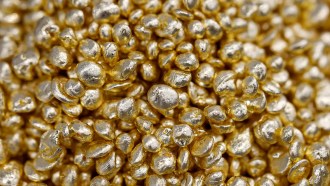
copper: A metallic chemical element in the same family as silver and gold. Because it is a good conductor of electricity, it is widely used in electronic devices.
electrical conductivity: The ability of some substance (such as water or metals) to transport an electrical charge or current.
electronics: Devices that are powered by electricity but whose properties are controlled by the semiconductors or other circuitry that channel or gate the movement of electric charges.
element: A building block of some larger structure. (in chemistry) Each of more than one hundred substances for which the smallest unit of each is a single atom. Examples include hydrogen, oxygen, carbon, lithium and uranium.
iron: A metallic element that is common within minerals in Earth’s crust and in its hot core. This metal also is found in cosmic dust and in many meteorites.
magnet: A material that usually contains iron and whose atoms are arranged so they attract certain metals.
metal: Something that conducts electricity well, tends to be shiny (reflective) and is malleable (meaning it can be reshaped with heat and not too much force or pressure).
millennia: (singular: millennium) Thousands of years.
oxygen: A gas that makes up about 21 percent of Earth's atmosphere. All animals and many microorganisms need oxygen to fuel their growth (and metabolism).
resilient: (n. resilience) To be able to recover fairly quickly from obstacles or difficult conditions. (in materials) The ability of something to spring back or recover to its original shape after bending or otherwise contorting the material.
skyscraper: A very tall building.
superconductor: Materials that have no resistance to the flow of electricity, typically only when they are cooled below a certain temperature. Superconductors also repel all magnetic fields, which allows them to float in the air when they are placed inside a strong magnetic field.
warp: A change in the shape, usually due to some twisting or curving in a normally flat surface or plane. A piece of wet lumber may warp as it dries unevenly, causing it to bow or show a slight twist.