Questions for ‘Knotted strands of 500-year-old hair tell a surprising story’
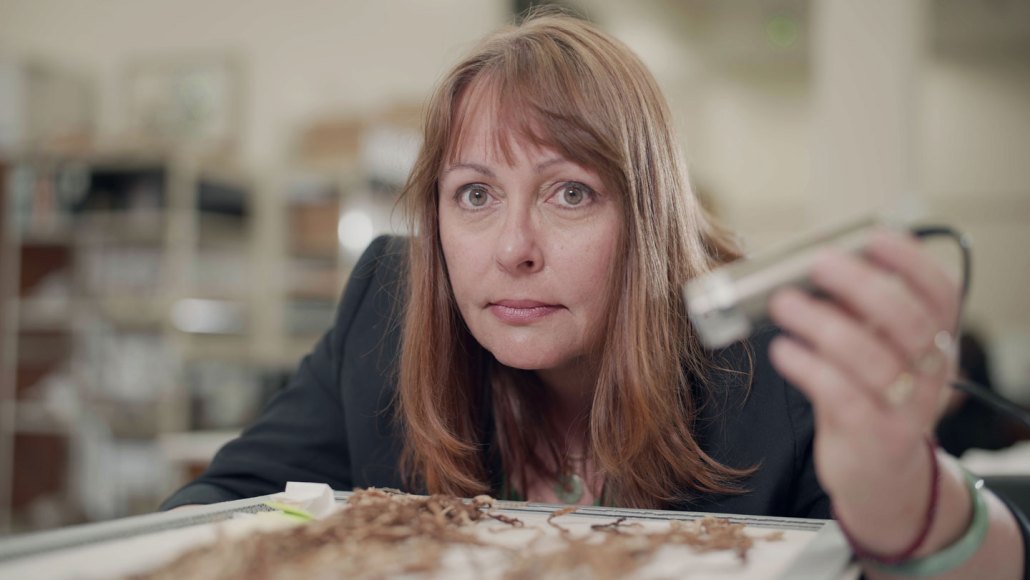
Anthropologist Sabine Hyland examines an Inca recordkeeping device called a khipu.
Gabriel Buti
Share this:
- Share via email (Opens in new window) Email
- Share on Facebook (Opens in new window) Facebook
- Share on X (Opens in new window) X
- Share on Pinterest (Opens in new window) Pinterest
- Share on Reddit (Opens in new window) Reddit
- Share to Google Classroom (Opens in new window) Google Classroom
- Print (Opens in new window) Print
To accompany ‘Knotted strands of 500-year-old hair tell a surprising story’
SCIENCE
Before Reading:
1. Imagine you must recall a certain number at this time next week to win a prize. Let’s say that number is 51,479,772. But here’s the catch: You are not permitted to write this number down anywhere or in any form. The only tool permitted to you for possible record-keeping is a string. Devise a way that you might use this string to record this number.
2. Give an example of an ancient culture that you associate with extensive recordkeeping. To the best of your knowledge, what type of things did this society keep record on? Briefly explain why those things would have been important to record.
During Reading:
1. With which ancient culture do archeologists most closely associate khipus?
2. How did the Spanish describe the role of a khipu? What were some possible uses?
3. What potentially inaccurate assumption did Sabine Hyland make regarding the khipu described in this story?
4. What scientific process did researchers use to determine the age of the hair? Did they determine the hair to be older or younger than 500 years?
5. How long do researchers estimate this hair took to grow?
6. Based on the estimated time for this hair to grow and the hair’s length (as mentioned in the story), determine the average growth per year in centimeters.
7. What type of chemical analysis allowed researchers to estimate the hair owner’s diet? Explain what researchers did.
8. Based on their analyses, what information do researchers think they know about the person who made the khipu?
After Reading:
1. What surprised researchers about the hair owner’s diet? What evidence supported this conclusion? Based on the hair owner’s diet, what conclusion did researchers make about the hair owner’s status in their community? Are there any other possible explanations for the hair owner’s diet? Explain your answer.
2. In this study, scientists used radiocarbon dating, which is used to determine the age of objects containing organic materials. Explain why the method works. If you need background, read this Explainer article from Science News Explores.