Earth's Systems
- Climate
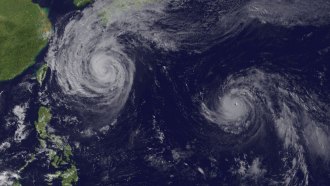
New El Niño coming on strong
The current El Niño event could be a record breaker, changing weather patterns worldwide and bringing rain to drought-parched California.
- Climate
Scientists ‘see’ thunder for first time
Scientists have captured the first image of thunder. The map shows the relative strengths of the sound waves emanating from the loud clap.
- Earth
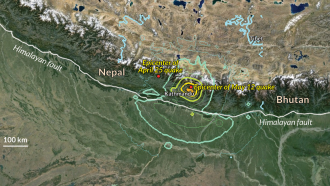
Major new quake rattles Nepal
A new earthquake struck Nepal on May 12. Its tremors were centered on a new region.
- Climate
Warming’s role in extreme weather
Extremes in temperature and precipitation will be more common as global temperatures rise. Human-led climate change is largely to blame, a new study finds.
- Climate
Cosmic rays offer clues about lightning
Space particles called cosmic rays pelt Earth. Scientists are using the rain of these particles to probe how lightning forms.
- Earth
Nepal earthquake offers hints of worse to come
The magnitude 7.8 earthquake that crumbled much of Nepal’s capital city could be overshadowed by larger future earthquakes along the Himalayas, scientists say.
- Climate
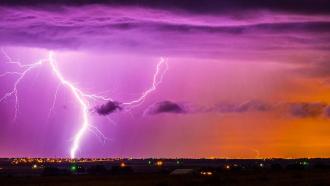
Mornings become electric
Lightning packs a wallop in the morning. The most powerful lightning strikes in the continental United States usually peak before noon.
- Microbes
Life’s ultra-slow lane is deep beneath the sea
Biologists had suspected the deep seafloor would be little more than barren sediment. But they found a surprising amount of oxygen — and life.
- Earth
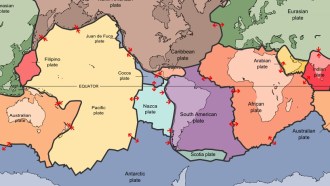
Explainer: Understanding plate tectonics
Plate tectonics is the process whereby Earth continually rebuilds itself — and causes destructive events like earthquakes and volcanic eruptions.
- Climate
Arctic warming bolsters summer heat
Rapid warming in the Arctic is sapping summer storms of their power to cool. That worsens heat waves across the Northern Hemisphere.
- Earth
Ancient ocean linked to supercontinent’s breakup
The supercontinent Pangaea started breaking apart 200 million years ago. This may have been triggered by the shrinking of the Tethys Ocean, a new study finds.
- Climate
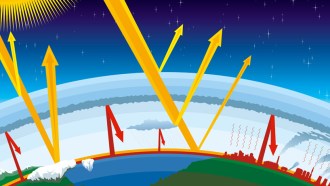
Scientists confirm ‘greenhouse’ effect of human’s CO2
Government scientists link directly, for the first time, a boost in warming at Earth’s surface to increasing levels of carbon dioxide. Much of that gas has been released by human activities, such as coal burning and gas-burning vehicles.