HS-ESS1-2
Construct an explanation of the Big Bang theory based on astronomical evidence of light spectra, motion of distant galaxies, and composition of matter in the universe.
- Life
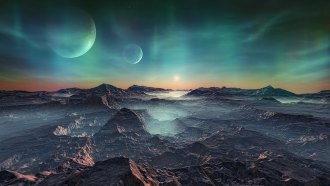
Planets with hydrogen skies could harbor life
Microbes can live in a hydrogen atmosphere. This points to new space worlds that host alien life.
- Space
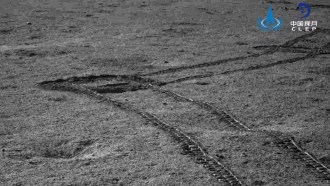
Rover finds ‘layer cake’ below ground on moon’s farside
China’s rover finds the moon’s farside is more rugged and cratered than the nearside. Now scientists want to know why.
- Space
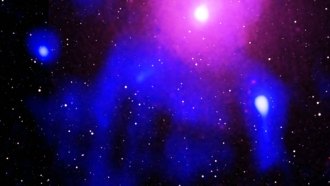
Black hole mega-burp was truly explosive
Long, long ago, in a galaxy far, far away, a black hole blasted out 100 billion times as much energy as our sun ever will. One word for that: Wow!
- Space
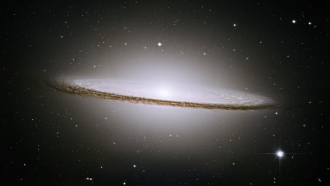
This ‘Sombrero’ stole a big galaxy
The Sombrero Galaxy is an odd spiral galaxy that outshines all others within 35 million light-years of Earth. Its bright, iron-rich halo suggests it consumed one or more large galaxies.
- Physics
Glass beads help scientists puzzle out how baby planets grow
Researchers have mimicked the first stages of planet formation in the lab. All they needed were glass beads and a catapult.
- Physics
NASA’s Parker probe spots rogue waves and magnetic islands on the sun
The Parker probe’s first data is giving scientists a look at what’s to come as the craft moves closer to the sun over the next few years.
- Physics
Dust-shrouded monster is a snapshot from the early universe
Scientists have spotted a massive galaxy from the early universe shrouded in dust. It turned up in a small survey by the ALMA radio telescopes in Chile.
- Physics
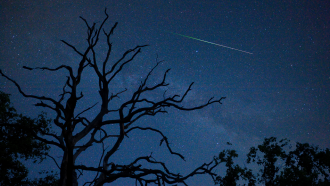
Explainer: Understanding meteors and meteor showers
Meteors regularly enter Earth’s atmosphere. Most ‘shooting stars’ pose few risks to life on the ground, but the rare big ones can be lethal.
- Physics
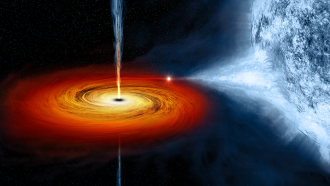
Explainer: What are black holes?
Among the most extreme celestial bodies in the universe, black holes are dense, massive entities whose gravity can sometimes hold together an entire galaxy.
- Chemistry
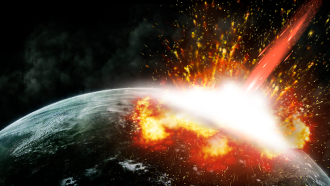
Asteroids may have delivered water to early Earth
Scientists shot mineral pellets at a simulated planet. It showed an impact wouldn’t have boiled off all of an asteroid’s water.
- Planets
Small, distant worlds are either big Earths or little Neptunes
The Kepler space telescope data are in. They split Earth-like exoplanets into two groups and reveal 10 new rocky planets in the ‘Goldilocks’ zone.
- Planets
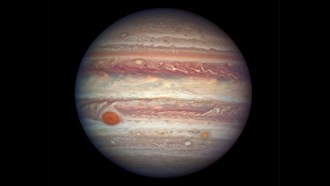
Jupiter may be the solar system’s oldest planet
Jupiter’s early existence may explain the odd arrangement of planets in the solar system, a new study suggests.