HS-ETS1-3
Evaluate a solution to a complex real-world problem based on prioritized criteria and trade-offs that account for a range of constraints, including cost, safety, reliability, and aesthetics, as well as possible social, cultural, and environmental impacts.
- Animals
A new drug mix helps frogs regrow amputated legs
The treatment helped frogs grow working limbs useful for swimming, standing and kicking. It’ll be a while before people can do that.
- Chemistry
Clothes dryers may be a major source of airborne microplastics
Scientists thought washing machines were a leading contributor of microplastics. Now it appears dryers may be an even bigger problem.
- Physics
Analyze This: Masks cut the distance that spit droplets fly
Both cloth masks and surgical masks reduced the distance spit traveled from a person talking or coughing by at least half, compared with no mask.
- Climate
Let’s learn about the science of the Winter Olympics
From scientific innovations to climate change and weather, there’s plenty of science to be found among the feats of amazing athleticism.
- Animals
DNA in air can help ID unseen animals nearby
Analyzing these genetic residues in air offers a new way to study animals. It could give scientists a chance to monitor rare or hard to find animals.
- Ecosystems
Recycling a climate-warming gas could make ‘greener’ farmed fish
Instead of warming the climate, methane gas can be collected to help farmers. Along the way, it may also save some fish.
- Tech
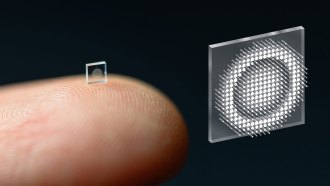
This crumb-sized camera uses artificial intelligence to get big results
Researchers have developed a camera the size of a coarse grain of salt that takes amazingly clear photos.
- Physics
Explainer: Telescopes see light — and sometimes ancient history
Different kinds of telescopes on Earth and in space help us to see all wavelengths of light. Some can even peer billions of years back in time.
- Planets
The long-awaited James Webb Space Telescope has a big to-do list
The James Webb Space Telescope has been in the works for so long that new fields of science have emerged for it to study.
- Chemistry
Snail slime + gold could boost the power of sunscreens and more
These two strange ingredients could make skin-care products that are better for both our skin and the environment.
- Materials Science
Analyze This: This material for 3-D printing is made by microbes
Bacteria with tweaked genes pump out proteins that can be used in a 3-D printer. With microbes in the mix, the living ink can make drugs or suck up chemicals.
- Chemistry
Could reusable ‘jelly ice’ cubes replace regular ice?
These hydrogel “jelly ice cubes” are made mostly of gelatin and water. They won’t melt, even when thawed, and may provide new food cooling options.