HS-PS4-1
Use mathematical representations to support a claim regarding relationships among the frequency, wavelength, and speed of waves traveling in various media.
- Physics
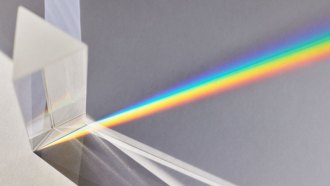
Explainer: Reflection, refraction and the power of lenses
The inner workings of microscopes, telescopes, eyeglasses and other lens-based devices rely on two important laws of optics.
- Tech
Nanocrystal ‘painted’ films may someday help relieve summer heat
The rainbow palette and cooling powers of new plant-based films comes from their microscopic surface patterns of tiny crystals.
- Tech
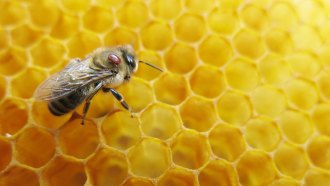
A device spots and counts honeybees hosting a dangerous parasite
At Regeneron ISEF, three teens debuted an infrared system to detect honeybees carrying mites. It can show beekeepers when a colony needs to be treated.
- Physics
A powerful laser can control the paths that lightning takes
In a mountaintop experiment, a laser beamed at the sky created a virtual lightning rod that snagged several bolts.
- Tech
Think of this new tech as sunglasses for our windows
Keeping buildings cool can use a lot of energy. Thanks to quantum computing, engineers designed a coating to cut the warming light that enters windows.
- Materials Science
Let’s learn about piezoelectric materials
Piezoelectric materials turn mechanical energy into electrical energy — and vice versa.
- Computing
A single chip like this could transmit a world’s worth of data
The internet has a big environmental footprint. But this new type of tech could help reduce the climate impact of computing.
- Physics
In a breakthrough experiment, fusion gave off more energy than it used
The sun creates energy through nuclear fusion. Now scientists have too. This achievement raises hopes for developing a new type of clean energy.
- Earth
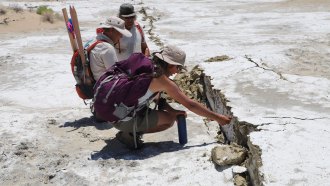
Scientists Say: Seismology
Seismology is the branch of science focused on seismic waves — vibrations that run through or around Earth.
- Chemistry
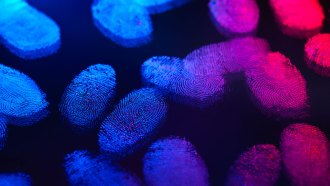
Was that fingerprint left during a crime? A new test may answer that
In what could be a boon to forensics, Iowa State University chemists have come up with a way to analyze the age of fingerprints.
- Tech
Will the internet soon reach the one-third of people without it?
Access to the internet is a human right, yet much of the world can’t get online. New tech has to be affordable and usable to end this digital divide.
- Chemistry
Scientists Say: Fluorescence
This property causes materials — including some animals’ skin, fur or feathers — to glow under light.