HS-PS4-1
Use mathematical representations to support a claim regarding relationships among the frequency, wavelength, and speed of waves traveling in various media.
- Materials Science
These fabrics change color as they stretch
Stretchy, color-shifting cloth may lead to new art, fashions and sensors. A century-old Nobel-prize-winning invention served as its inspiration.
- Planets
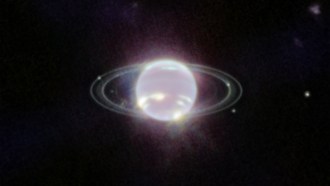
Check out the first direct look at Neptune’s rings since the ’80s
The Voyager 2 spacecraft took the first pics of Neptune’s rings 33 years ago. Now, NASA’s James Webb telescope is providing a more detailed view of them.
- Physics
Cosmic timeline: What’s happened since the Big Bang
Energy, mass and the cosmos' structure evolved a lot over the past 13.82 billion years — much of it within just the first second.
- Earth
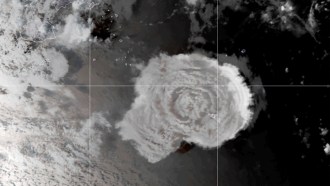
One 2022 tsunami may have been as tall as the Statue of Liberty
A massive volcanic eruption in the South Pacific, earlier this year, appears to have triggered one tsunami that was initially 90 meters (nearly 300 feet) tall.
- Physics
Let’s learn about music
Researchers are delving into how instruments and spaces shape our experience of music, and how computers could play a role in the future of music-making.
- Climate
Coastal cities around the world are sinking, satellite data show
Of 99 coastal cities studied, nearly one-third are sinking. This leaves coastal communities increasingly vulnerable to rising seas.
- Animals
Orb-weaving spiders use their webs like external eardrums
Scientists discover that orb-weaving spiders listen with their legs, detecting sound vibrations that travel through their silken webs.
- Physics
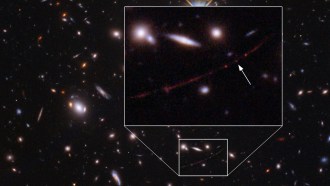
A star called ‘Earendel’ could be the most distant ever seen
A thin red arc found in an image from the Hubble Space Telescope shows starlight from nearly 13 billion years ago.
- Archaeology
Muons reveal the inner worlds of pyramids, volcanoes and more
Tracking these subatomic particles can uncover surprising hidden structures.
- Physics
Gravitational waves ‘kicked’ a newborn black hole across space
Two black holes merged into one, and then sped off at around 5 million kilometers (3.1 million miles) per hour.
- Space
We finally have an image of the black hole at the heart of our galaxy
New observations from the Event Horizon Telescope reveal the chaotic region around the Milky Way’s central black hole, Sagittarius A*, in extreme detail.
- Planets
Analyze This: Some 5,000 planets orbit stars other than our sun
A new cache of confirmed exoplanet discoveries marks a milestone in planets found beyond our solar system.