HS-PS4-1
Use mathematical representations to support a claim regarding relationships among the frequency, wavelength, and speed of waves traveling in various media.
- Physics
Neutrons are unveiling hidden secrets of fossils and artifacts
Images made with these particles have revealed details of dinosaur bones, mummies and more.
- Oceans
Shading corals during midday heat can limit bleaching
Shading coral reefs during the sunniest part of the day may help corals survive marine heat waves.
- Tech
Bionic plants and electric algae may usher in a greener future
Some can aid the climate by removing pollutants. Others would just avoid dirtying the environment in the first place.
- Physics
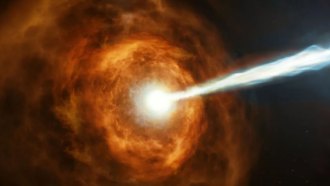
Scientists Say: Gamma ray
Lightning bolts, nuclear explosions, colliding stars and black holes all throw off this high-energy type of light.
- Physics
Scientists Say: Ultrasonic
This word describes sound waves that have frequencies too high for human ears to hear.
- Tech
Talking through a tube can trick AI into mistaking one voice for another
Researchers crafted tubes that can trick AI into mistaking one person’s voice for another’s. Bad guys could use such tricks to hack into accounts.
- Physics
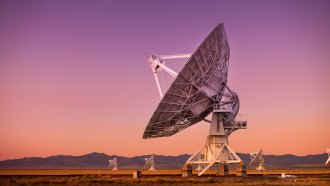
Scientists Say: Radio Waves
Lightning, stars, supermassive black holes and more give off radio waves.
- Oceans
How would a mermaid sound underwater?
Human ears don’t work well in the water. A mermaid would need marine creature features to talk to and understand her aquatic friends.
- Plants
A single particle of light can kick off photosynthesis
In a new experiment with bacteria, a lone photon sparked the process of turning light to chemical energy.
- Physics
Shouting into the wind may seem futile — but it’s really not
Sending a sound upwind, against the flow of air, actually makes the sound louder — only it doesn’t sound that way to the person making the noise.
- Materials Science
Analyze This: A new fabric mimics polar bears’ pelts for warmth
With layers that work like polar bears’ skin and fur, a material absorbs light and keeps it from escaping.
- Planets
In a first, telescopes have caught a star eating a planet
A burst of light and a cloud of dust are signs that a distant star swallowed a giant planet.