MS-PS2-2
Plan an investigation to provide evidence that the change in an object's motion depends on the sum of the forces on the object and the mass of the object.
- Physics
Forests could help detect ‘ghost particles’ from space
If trees could act as natural antennas, one physicist proposes that they just might pick up signals of hard-to-spot ultra-high energy neutrinos.
- Physics
Physics explains what happens when a lawn sprinkler sucks in water
Experiments with a floating sprinkler revealed the surprisingly complex physics behind a simple question.
- Physics
How much fruit can you pull from a display before it topples?
About 10 percent of the fruit in a tilted market display can be removed before it will crash down, computer models show.
- Physics
Explainer: What is friction?
The force of friction always acts to slow things down. It depends on just two factors: the surfaces and how hard they press together.
- Plants
Why dandelions are so good at widely spreading their seeds
Individual seeds on a dandelion release most easily in response to winds from a specific direction. As the wind shifts, this scatters the seeds widely.
- Animals
Analyze This: Bulky plesiosaurs may not have been bad swimmers after all
Long-necked plesiosaurs were thought to be slow swimmers. But new research suggests the animals’ large size helped them overcome water resistance.
- Physics
Scientists Say: Force
When an object experiences a force, its change in motion — or acceleration — depends on its mass.
- Physics
You might someday ‘wallpaper’ your bedroom with this loudspeaker
This thin, flexible and lightweight loudspeaker could reduce noise in loud spaces. It also might enable listeners to experience sound in new ways.
- Physics
When dominoes fall, how fast the row topples depends on friction
Two types of friction help determine how quickly a line of dominoes collapses, computer modeling shows.
- Physics
Scientists Say: Inertia
Inertia is the tendency of objects to resist changes in their motion.
- Animals
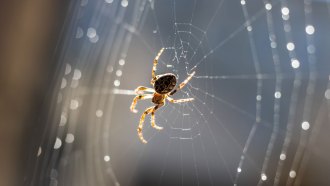
Orb-weaving spiders use their webs like external eardrums
Scientists discover that orb-weaving spiders listen with their legs, detecting sound vibrations that travel through their silken webs.
- Physics
Explainer: All about orbits
A handful of rules can describe the route some object repeatedly takes around another in space. Calculating that path, however, can be quite complex.