Waves and Their Applications in Technologies for Information Transfer
- Physics
Let’s learn about music
Researchers are delving into how instruments and spaces shape our experience of music, and how computers could play a role in the future of music-making.
- Physics
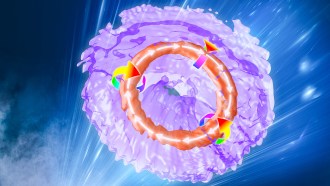
Scientists used lasers to make ‘smoke rings’ of light
Physicists had a bright idea: Make light into swirling, ring-shaped vortices, similar to smoke rings or bubble rings.
- Physics
You might someday ‘wallpaper’ your bedroom with this loudspeaker
This thin, flexible and lightweight loudspeaker could reduce noise in loud spaces. It also might enable listeners to experience sound in new ways.
- Chemistry
Simple process destroys toxic and widespread ‘forever’ pollutants
Ultraviolet light, sulfite and iodide break down these PFAS molecules faster and more thoroughly than other methods.
- Physics
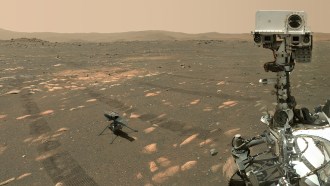
Noises sound totally different on Mars than on Earth. Here’s why
The Perseverance rover recorded the sound of laser pulses on Mars. Scientists used those recordings to determine the Martian speeds of sound.
- Science & Society
A new audio system confuses smart devices that try to eavesdrop
It works by playing soft, calculated sounds to help people protect their privacy from automatic speech-recognition systems.
- Climate
Coastal cities around the world are sinking, satellite data show
Of 99 coastal cities studied, nearly one-third are sinking. This leaves coastal communities increasingly vulnerable to rising seas.
- Earth
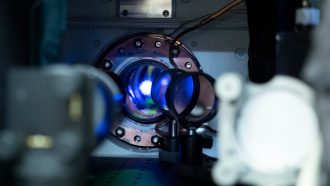
A new clock shows how gravity warps time — even over tiny distances
This clock measured how gravity changes the passage of time in different places — even spots just one millimeter apart.
- Animals
Orb-weaving spiders use their webs like external eardrums
Scientists discover that orb-weaving spiders listen with their legs, detecting sound vibrations that travel through their silken webs.
- Physics
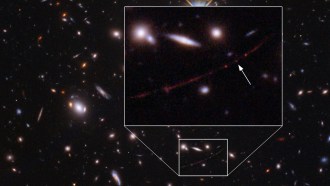
A star called ‘Earendel’ could be the most distant ever seen
A thin red arc found in an image from the Hubble Space Telescope shows starlight from nearly 13 billion years ago.
- Archaeology
Muons reveal the inner worlds of pyramids, volcanoes and more
Tracking these subatomic particles can uncover surprising hidden structures.
- Physics
Gravitational waves ‘kicked’ a newborn black hole across space
Two black holes merged into one, and then sped off at around 5 million kilometers (3.1 million miles) per hour.