Scientists Say: Vitamin
These dietary essentials support immunity, enable night vision and more
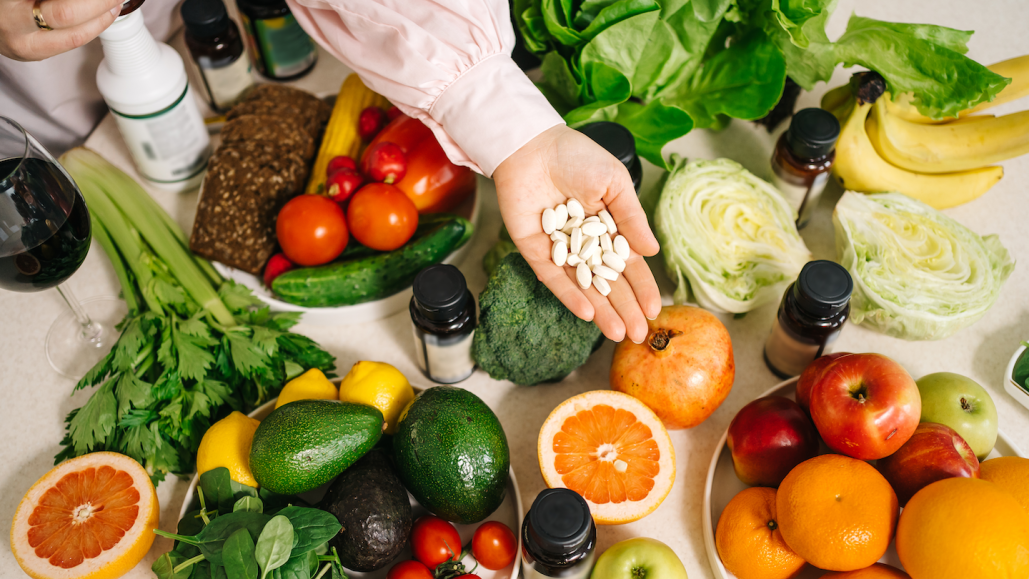
Multivitamin pills do not replace a healthy diet of vitamin-rich fruits and vegetables. But they may help fill some nutritional gaps.
Svetlana Repnitskaya/Getty Images Plus
Share this:
- Share via email (Opens in new window) Email
- Share on Facebook (Opens in new window) Facebook
- Share on X (Opens in new window) X
- Share on Pinterest (Opens in new window) Pinterest
- Share on Reddit (Opens in new window) Reddit
- Share to Google Classroom (Opens in new window) Google Classroom
- Print (Opens in new window) Print
Vitamin (noun, “VITE-ah-men”)
Vitamins are carbon-containing chemicals that living things must consume in small amounts to live.
Our body can create many molecules crucial for life. DNA is one example. So are proteins such as collagen. But the body cannot create most vitamins. Or at least, it cannot make enough of them. Therefore, we must get them through our diet.
Consider multivitamin pills you might buy from a drugstore. The bottle may advertise that it contains many different vitamins. Vitamins A, C, D and B are some examples. These names usually refer to groups of molecules rather than specific ones. Vitamin B alone includes B1, B2, B3, B5, B6, B7, B9 and B12.
We get many vitamins from food. But we do not generally digest them for energy. Instead, they serve other functions in our bodies.
Take vitamin B. Natural sources of B vitamins include fish, eggs and meat. In our body, these compounds support nerve function. They also help our body generate usable energy from our food. B9 — or folate — aids in cell growth and division.
Vitamin D helps the body absorb essential minerals, such as calcium and phosphate, from food. Vitamin C helps skin injuries heal properly. It also supports our immune system. Vitamin A helps us see in the dark, among other things.
Different vitamins come with different properties. Some dissolve in water. Others — such as vitamins A and D — get absorbed by fats. Some vitamins resist getting broken down by the body. Others are more delicate. For example, fragile vitamin C breaks down readily in sunlight and heat. Many techniques used to preserve food degrade this vitamin. So, fresh fruits and vegetables remain the best natural sources of vitamin C.
In a sentence
No-heat techniques for preserving fruits may help conserve delicate vitamins.
Check out the full list of Scientists Say.
What’s in a name?
The word “vitamin” reflects just how important these molecules are to our health.
In the early 1900s, Polish chemist Casimir Funk suggested that certain molecules, when lacking in a person’s diet, can cause people to become very sick. This included a molecule that he identified, vitamin B3, or niacin.
Niacin belongs to a group of molecules called amines. Amines are molecules that include a cluster of atoms containing a nitrogen atom. Funk suggested there must be other, similar amines — which he called “vital amines” — that are essential for life.
Funk’s research led to the discovery of many more of these “vital amines,” though not all of them are amines. But the name stuck —today we know those compounds as vitamins.