HS-ETS1-2
Design a solution to a complex real-world problem by breaking it down into smaller, more manageable problems that can be solved through engineering.
- Tech
A new solar-powered gel purifies water in a flash
The unusual, fruit-inspired structure of this material provides quick filtration that could satisfy people's daily water needs.
- Tech
Magnetic fields melt and re-form new shape-shifting devices
Miniature machines made of gallium and magnetic particles can switch from solid to liquid and back.
- Chemistry
Chemists have unlocked the secrets of long-lasting Roman concrete
By searching ancient texts and ruins, scientists found a concrete recipe that could make buildings stronger — and help address climate change.
- Environment
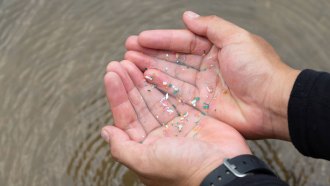
Sea life may suffer as plastic bits alter metals in water
This interplay between plastics and metals could affect how each affects the environment — and suggests opportunities for controlling their risks.
- Climate
Here’s how to increase clean energy without harming wildlife
Wind farms, solar panels and more take up land and may harm wildlife. Researchers are working to resolve this conflict.
- Physics
A powerful laser can control the paths that lightning takes
In a mountaintop experiment, a laser beamed at the sky created a virtual lightning rod that snagged several bolts.
- Tech
Think of this new tech as sunglasses for our windows
Keeping buildings cool can use a lot of energy. Thanks to quantum computing, engineers designed a coating to cut the warming light that enters windows.
- Health & Medicine
High school scientists tackle community health and safety risks
Three finalists in the 2023 Regeneron Science Talent Search aim to improve suicide risk assessment, treatment of sickle cell disease and more.
- Computing
A single chip like this could transmit a world’s worth of data
The internet has a big environmental footprint. But this new type of tech could help reduce the climate impact of computing.
- Physics
In a breakthrough experiment, fusion gave off more energy than it used
The sun creates energy through nuclear fusion. Now scientists have too. This achievement raises hopes for developing a new type of clean energy.
- Chemistry
Scientists Say: Rubisco
Rubisco is a key protein in the process of photosynthesis, which feeds plants — and, in turn, us.
- Computing
Sleep helps AI models learn new things without forgetting old ones
Breaks in training meant to mimic human sleep helped artificial intelligence learn multiple tasks.