HS-LS2-2
Use mathematical representations to support and revise explanations based on evidence about factors affecting biodiversity and populations in ecosystems of different scales.
- Earth
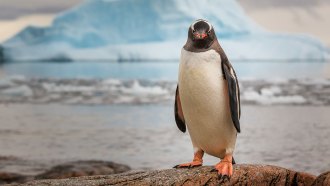
Let’s learn about Antarctica
This continent is dry, windy and very cold — and home to penguins, ice and a lot of scientific research.
- Animals
Spiders can take down and feast on surprisingly big snakes
Snared in sticky webs and subdued by poison, even venomous snakes can become a spider’s soup.
- Climate
‘Zombie’ wildfires can reemerge after wintering underground
Climate change may make these not-quite-dead blazes more common. Scientists are learning to predict where a zombie might emerge.
- Life
Let’s learn about microbes
There may be a billion species of microorganisms on Earth — but scientists have only discovered a small fraction of them.
- Plants
These ferns may be first plants known to work together as ants do
Staghorn ferns grow in massive colonies where individual plants contribute different jobs. This may make them “eusocial,” like ants or termites.
- Health & Medicine
Will we all need COVID-19 booster shots?
Experts say not yet, but booster vaccines may be coming as new SARS-CoV-2 virus variants keep emerging.
- Animals
Common parasite may help mussels survive heat waves
By whitening shells, the organism helps the shellfish stay cool on sunny days, a new study suggests.
- Animals
Most species of beetles pee differently than other insects
Scientists uncover their unique system for balancing ions and water. The findings may hint at why beetles are the most diverse animals on Earth.
- Environment
Pond scum can release a paralyzing pollutant into the air
New study finds blooms of blue-green algae can seed the air with a poisonous pollutant.
- Animals
Only 3 percent of Earth’s land is unchanged by people
A sweeping survey of land-based ecosystems finds that very few still support all the animals they used to. Reintroducing lost species could help.
- Animals
Analyze This: Invasive species cost the world billions each year
A new study estimates that invasive species have cost the world more than $1 trillion since 1970. That’s almost certainly an underestimate.
- Animals
How bees play telephone to form a swarm
Honeybees use pheromones and flapping wings to tell each other where to find the queen — so they can all be together. Learn more with this web comic.