HS-LS2-8
Evaluate the evidence for the role of group behavior on individual and species' chances to survive and reproduce.
- Health & Medicine
What is the role of in-person classes in COVID-19’s spread?
New data haven’t shown that schools pose a big coronavirus risk to kids and their families, despite fears that they might.
- Animals
Even raised by people, wolves don’t tune into you like your dog
Dog puppies outpace wolf pups at engaging with humans, even with less exposure to people, supporting the idea that domestication changed dogs’ brains.
- Animals
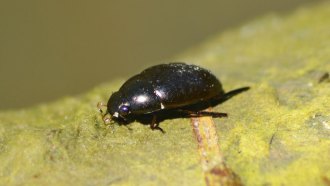
Some beetles walk along the underside of the water’s surface
Their upside-down scurrying is a rare method of getting around.
- Animals
Dinosaur families appear to have lived in the Arctic year-round
Fossils of baby dinosaurs in northern Alaska challenge the idea that northern dinosaurs only spent their summers in the high Arctic.
- Animals
Spiders can take down and feast on surprisingly big snakes
Snared in sticky webs and subdued by poison, even venomous snakes can become a spider’s soup.
- Life
Let’s learn about microbes
There may be a billion species of microorganisms on Earth — but scientists have only discovered a small fraction of them.
- Animals
A bubble of air lets some lizards breathe underwater
Anolis lizards leap into streams to escape danger. Now researchers have figured out how they can stay underwater for up to a quarter of an hour.
- Plants
These ferns may be first plants known to work together as ants do
Staghorn ferns grow in massive colonies where individual plants contribute different jobs. This may make them “eusocial,” like ants or termites.
- Animals
Urchin mobs can literally dis-arm a predator
Urchins are important herbivores — but not strict vegetarians. When hungry enough, they may even rip apart their predators for lunch.
- Animals
Let’s learn about whales and dolphins
Whales, dolphins and porpoises are all cetaceans — mammals that live in water and have a streamlined body similar to a fish.
- Health & Medicine
Will we all need COVID-19 booster shots?
Experts say not yet, but booster vaccines may be coming as new SARS-CoV-2 virus variants keep emerging.
- Animals
Common parasite may help mussels survive heat waves
By whitening shells, the organism helps the shellfish stay cool on sunny days, a new study suggests.