HS-PS2-6
Communicate scientific and technical information about why the molecular-level structure is important in the functioning of designed materials.
- Tech
Nanocrystal ‘painted’ films may someday help relieve summer heat
The rainbow palette and cooling powers of new plant-based films comes from their microscopic surface patterns of tiny crystals.
- Tech
A new solar-powered gel purifies water in a flash
The unusual, fruit-inspired structure of this material provides quick filtration that could satisfy people's daily water needs.
- Tech
Magnetic fields melt and re-form new shape-shifting devices
Miniature machines made of gallium and magnetic particles can switch from solid to liquid and back.
- Chemistry
Chemists have unlocked the secrets of long-lasting Roman concrete
By searching ancient texts and ruins, scientists found a concrete recipe that could make buildings stronger — and help address climate change.
- Tech
Think of this new tech as sunglasses for our windows
Keeping buildings cool can use a lot of energy. Thanks to quantum computing, engineers designed a coating to cut the warming light that enters windows.
- Climate
Creating less new stuff could greatly help Earth’s climate
Instead of throwing unneeded things away, scientists recommend moving to a cycle of reducing, reusing, repairing and remaking old things into new ones.
- Materials Science
Let’s learn about piezoelectric materials
Piezoelectric materials turn mechanical energy into electrical energy — and vice versa.
- Tech
New robot can pick up a single drop of liquid
The new device, which looks like a pair of plastic pinchers, is the first to be able to pick up individual droplets of liquid.
- Materials Science
Scientists Say: Hydrogel
Tangled polymer chains help hydrogels hold their shape despite being full of water.
- Environment
For a better brick, just add poop
Sewage sludge. Cow dung. They’re not just waste — scientists are finding uses for processed poop in construction materials.
- Tech
Insect-inspired drones work together to 3-D print structures
For the first time, flying drones have 3-D printed structures. In the future, such drones might be able to build in hard-to-reach places.
- Tech
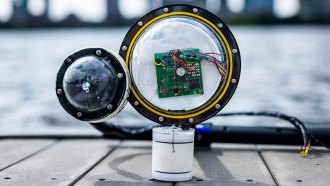
Underwater cameras get a new power source — sound!
Needing no batteries, a new digital camera can run almost continuously to offer new, deeper insights into the ocean world.