Waves and Their Applications in Technologies for Information Transfer
- Health & Medicine
Explainer: What is ultrasound?
These sound waves, which fall above the range of human hearing, are important in medicine, medical imaging and more.
- Physics
Explainer: What is the electric grid?
Most of us get electricity through a huge system of power lines and equipment that together are known as the electric grid. Here’s how it works.
- Tech
New eyewear could help the visually impaired
Young inventors develop novel electronics to help people identify colors and navigate obstacles.
- Computing
Fingerprints could help keep kids from dangerous websites
A teen develops a program that estimates age based on someone’s fingers
- Science & Society
Heating up the search for hidden weapons
Using an off-the-shelf camera and an innovative bit of software, a high-school student developed the means to inexpensively detect a hidden weapon.
-
Protecting deer with high-pitched noises
After her uncle crashed his truck into a deer, this teen decided to find out if there was a sound that would drive the animals away from roads.
- Earth
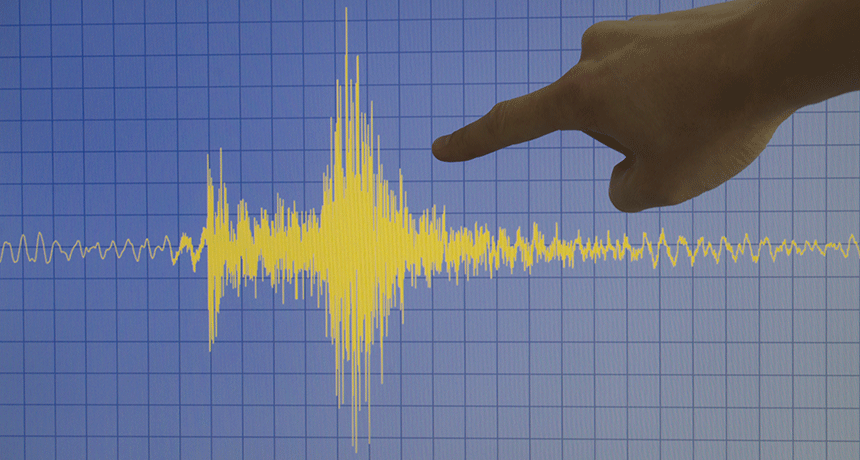
Explainer: Seismic waves come in different ‘flavors’
Earthquakes generate several different types of seismic waves, some more damaging than others
- Physics
Explainer: Quantum is the world of the super small
The word quantum often gets misused. What does it mean? Think small. Really, really small.
- Physics
Disabilities don’t stop these experts in science and tech
People with disabilities are as varied as the careers some of them pursue in science, technology, engineering and math.
- Chemistry
Scientists Say: Photochromic
Photochromic chemicals change shape when exposed to a specific wavelength of light. The shape change changes the chemical’s color.
- Health & Medicine
Scientists Say: Acoustic
Acoustic is an adjective used to describe something involving sound. It’s also a noun that refers to the branch of physics that studies sound.
- Physics
Gravitational waves detected yet again
For the third time in 16 months, scientists have announced detection of gravitational waves washing over the spacetime environment in which Earth resides. This seems to show that such waves may not be rare.