Physics
- Humans
Using physics can help athletes avoid sports injuries
Jessica Talmage uses physics to help understand how the body moves. Her findings help athletes avoid sports injuries and improve their performance.
- Tech
Scientists Say: Cryogenic
This deep-frozen field of science allows conservation biologists to preserve the DNA of endangered species and more.
- Chemistry
Explainer: What is chirality?
Chiral molecules are mirror images of each other. They might not seem all that different — but can have drastically different effects in medicine, materials and more.
- Physics
Precise tee placement can improve golf driving, teen finds
A homemade golf-ball-driving machine helped this middle-school engineer improve his own game.
- Space
Scientists Say: Spacetime
Weaving together the concepts of space and time allows scientists to understand gravity and more.
- Climate
As winters warm, athletes must cope with harder snow and tricky ice
Ice arenas and artificial snow now dominate the winter Olympics. Athletes there — and everywhere — may need to adjust how they train and perform.
- Animals
Is it possible to be invisible?
Fiction is full of characters with the power to vanish. But some animals have real-life ways to become nearly invisible.
- Physics
Energy may seem to disappear, but there’s a law against that
When a ball rolls to stop or a phone battery dies, it’s energy didn't vanish — it just morphed to another form. Energy is always conserved.
- Animals
Radioactive animals don’t glow — but do show the power of radiation
Wild species exposed to nuclear contamination help show how radiation affects living things — including its risks to people.
- Environment
Nuclear weapons tests many decades ago have left a radioactive legacy
Decades of aboveground nuclear weapons tests, starting in the 1950s, lightly littered the planet with toxic fallout, which appears to have sickened some people.
- Materials Science
‘Stenciling’ tiny gold particles gives them new properties
Decorating nanoparticles with other chemicals could give them useful properties for medicines, textiles and more.
- Fossils
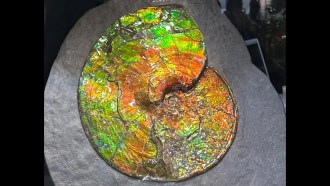
Here’s why ammolite gems have a rainbow shimmer
The fossils’ fabulous colors arise from delicate assemblies of crystal plates.