Space
- Health & Medicine
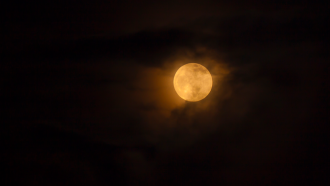
Does the moon influence people?
Unless you believe in werewolves (and you shouldn’t), there are few compelling data to suggest the moon has a big effect on people.
- Planets
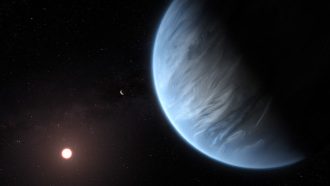
Spotted: An exoplanet where it might rain
A planet outside the solar system appears to have clouds with liquid water.
- Physics
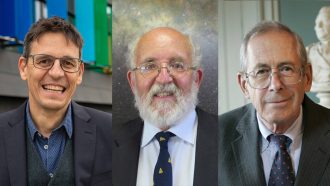
Physics Nobel rewards discoveries on cosmic evolution and exoplanets
This trio of scientists helped figure out the makeup of our universe. Two of them also identified the first known exoplanet orbiting a sunlike star.
- Planets
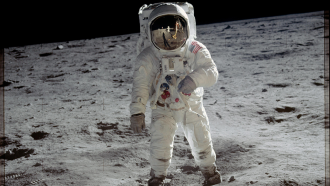
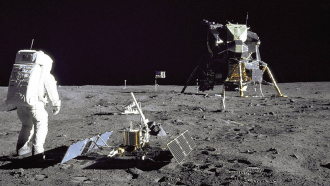
Learning from what Apollo astronauts left on the moon
In the 1960s and ’70s, Apollo astronauts left trash, mementos and science experiments on the moon. Researchers want to study and preserve the relics.
- Physics
Preserving remnants of human culture on the moon
Artifacts left behind by lunar landings have value to research and human history. Scientists now want to preserve those cast-offs while also learning from them.
- Planets
Students help name 5 of Jupiter’s newly discovered moons
Astronomers announced discovering 12 new moons of Jupiter in July 2018. Five of them now just been named for goddesses and spirits of Greek and Roman mythology.
- Materials Science
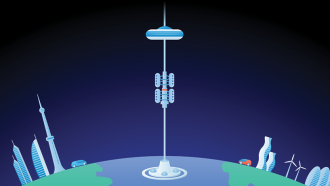
Could humans build a tall tower or giant rope to space?
The movie Ad Astra shows a space antenna, a spindly structure reaching up into the stars. We look at what it would take to build something that big.
- Space
Scientists Say: Galaxy
A galaxy is a group of millions to billions of stars, plus a lot of dust and gas.
- Planets
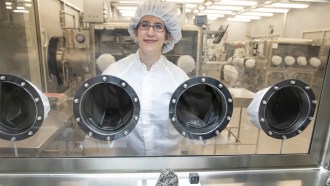
Welcome to moon rock central
A Science News reporter’s visit to NASA’s moon-rock lab shows the hyper-pristine conditions in which these rocks are kept — and why that’s so important.
- Physics
This idea would turn the Earth into a giant space telescope
One astronomer has a bold solution to getting around the high cost of building big telescopes.
- Space
The Milky Way is shaped like a curvy potato chip
Our galaxy’s got curves. You can see them in a chart of thousands of stars called Cepheids.
- Physics
Scientists Say: Big Bang
The Big Bang is the current theory about how our universe came to be. It began with a vast explosion of matter — a very Big Bang.