Space
- Space
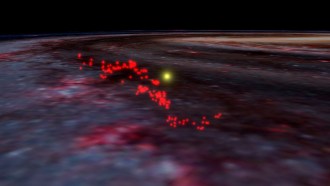
Our sun is neighbor to a giant wave of gas
The Earth and sun sit relatively close to a newfound thread of star-forming gas. That gas is being called the Radcliffe Wave.
- Space
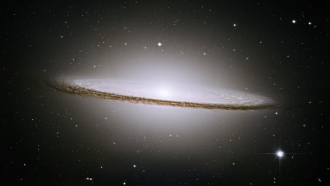
This ‘Sombrero’ stole a big galaxy
The Sombrero Galaxy is an odd spiral galaxy that outshines all others within 35 million light-years of Earth. Its bright, iron-rich halo suggests it consumed one or more large galaxies.
- Physics
Glass beads help scientists puzzle out how baby planets grow
Researchers have mimicked the first stages of planet formation in the lab. All they needed were glass beads and a catapult.
- Physics
NASA’s Parker probe spots rogue waves and magnetic islands on the sun
The Parker probe’s first data is giving scientists a look at what’s to come as the craft moves closer to the sun over the next few years.
- Physics
Dust-shrouded monster is a snapshot from the early universe
Scientists have spotted a massive galaxy from the early universe shrouded in dust. It turned up in a small survey by the ALMA radio telescopes in Chile.
- Physics
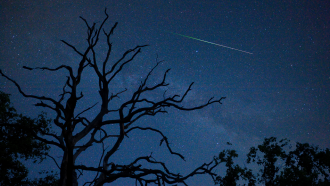
Explainer: Understanding meteors and meteor showers
Meteors regularly enter Earth’s atmosphere. Most ‘shooting stars’ pose few risks to life on the ground, but the rare big ones can be lethal.
- Physics
Magnetic fields may supercharge the sun’s release of heat
Astronomers have linked flame-like tendrils rising from the sun to changes in its magnetic fields. This may be one step toward understanding why the sun’s corona is so very, very hot.
- Physics
First heavy element identified from a neutron-star collision
Scientists have at last witnessed newborn strontium in the afterglow of a neutron-star smashup. It confirms what they had suspected about how many massive stars are created.
- Climate
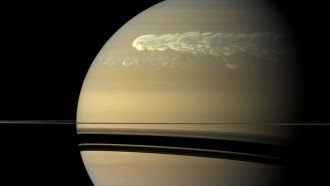
Astronomers spot new type of storm on Saturn
These storms are bigger and longer lasting than squalls but not nearly as massive as this planet's Great White Spots.
- Space
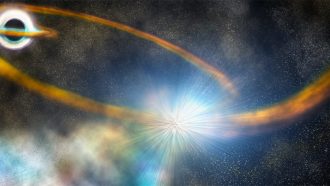
A black hole slashed a star apart — and was caught in the act
Scientists have gotten their earliest look yet at a black hole ripping up a star.
- Planets
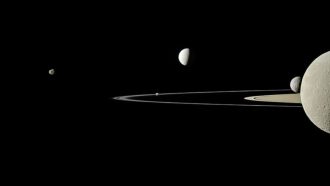
Saturn now reigns as the solar system’s ‘moon king’
Saturn now boasts at least 82 moons, surpassing Jupiter’s 79 natural satellites.
- Space
Scientists Say: Black hole
This is an object in space with such a strong gravitational pull that nothing, not even light, can escape