All Stories
- Planets
The InSight lander has caught a large ‘earthquake’ on Mars
This magnitude 5 quake is offering scientists a peek at what’s going on beneath the Martian surface.
- Archaeology
Bright-colored feathers may have topped pterosaurs’ heads
Fossil remains of a flying reptile hint that their vibrant crests may have originated 250 million years ago in a common ancestor with dinosaurs.
- Plants
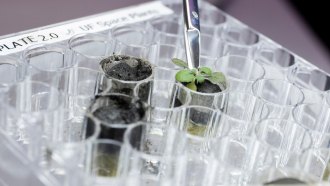
The first plants ever grown in moon dirt have sprouted
This tiny garden shows farming on the moon may be difficult, although not impossible.
- Science & Society
A new audio system confuses smart devices that try to eavesdrop
It works by playing soft, calculated sounds to help people protect their privacy from automatic speech-recognition systems.
- Animals
Let’s learn about amphibians
Amphibians are named after the Greek word for “double life” because many transform from water dwellers to landlubbers as they grow up.
- Earth
Tiny gemstones show when Earth’s crust first started moving
Chemical hints observed in zircons suggest when the important process of plate tectonics first took off.
- Archaeology
Scientists Say: Denisovan
The Denisovans were a recently discovered population of ancient hominids.
- Animals
Watch how a western banded gecko takes down a scorpion
New high-speed video reveals how normally mild-mannered geckos can violently shake venomous prey into submission.
- Earth
Cool Jobs: Bringing paleontology to the people
From museums to movies, these three paleontologists totally rock their connections with the public.
- Science & Society
Good at reading? That’s no sign girls won’t also cut it in STEM
U.S. parents read to their daughters, but few coach them on math. This may explain why girls excel at English but aren’t sure STEM is for them.
- Space
Behold: The biggest known comet in our solar system
This “dirty snowball” in space is about twice as wide as Rhode Island and darker than coal.
- Science & Society
Teens’ new tech would send alerts to reduce preventable deaths
A trio of teen innovations created devices that can speed up the response time to pool accidents, overheating in cars and combat-related injuries.