All Stories
- Animals
A dog’s breed doesn’t say much about its behavior
Many people associate dog breeds with specific behavioral traits. But breed appears to account for only about 9 percent of behavioral differences.
- Physics
Scientists Say: Inertia
Inertia is the tendency of objects to resist changes in their motion.
- Climate
Coastal cities around the world are sinking, satellite data show
Of 99 coastal cities studied, nearly one-third are sinking. This leaves coastal communities increasingly vulnerable to rising seas.
- Earth
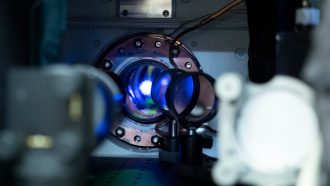
A new clock shows how gravity warps time — even over tiny distances
This clock measured how gravity changes the passage of time in different places — even spots just one millimeter apart.
- Animals
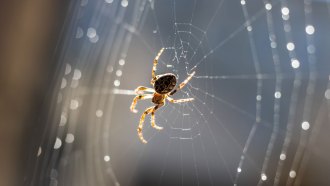
Orb-weaving spiders use their webs like external eardrums
Scientists discover that orb-weaving spiders listen with their legs, detecting sound vibrations that travel through their silken webs.
- Brain
Let’s learn about sleep
Sleep is key for health and wellbeing — but early school start times and screen time make it harder for teens to get shuteye.
- Physics
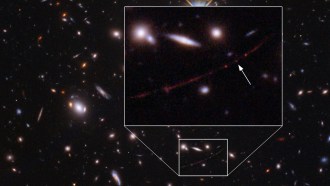
A star called ‘Earendel’ could be the most distant ever seen
A thin red arc found in an image from the Hubble Space Telescope shows starlight from nearly 13 billion years ago.
- Materials Science
Scientists Say: Silicone
Silicone is a generic term for a whole slew of humanmade polymers with many different forms and applications.
- Ecosystems
Some redwood leaves make food while others drink water
The two types of leaves grow at different heights in trees at dry versus wet areas. They may help redwoods adapt to climate change.
- Archaeology
Muons reveal the inner worlds of pyramids, volcanoes and more
Tracking these subatomic particles can uncover surprising hidden structures.
- Physics
Gravitational waves ‘kicked’ a newborn black hole across space
Two black holes merged into one, and then sped off at around 5 million kilometers (3.1 million miles) per hour.
- Physics
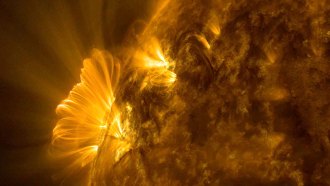
Some of the sun’s iconic coronal loops may be ghostly illusions
Wrinkles in the sun’s outer atmosphere might trick the eye into seeing glowing arches, scientists now report.