All Stories
- Humans
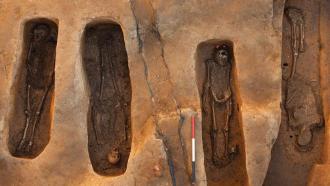
Jamestown: Unearthed graves tell tales of colony leaders
The newly uncovered 400-year-old remains of four leaders of the Jamestown settlement in Virginia reveal details of the notable’s lives — and deaths.
- Health & Medicine
Vaping can lead to teen smoking, new study finds
A study in L.A. high school students finds that those who vape are much more likely than those who don’t to eventually take up smoking cigarettes.
- Brain
Explainer: The nico-teen brain
Both e-cigarettes and tobacco products can release large amounts of nicotine during use. Nicotine is the chemical that makes tobacco addictive — and the teen brain is especially vulnerable to it.
- Physics
Fade to black? The universe is in decline
One of the largest sky surveys ever made has found that the universe is in decline. And after losing even more energy over the next 100 billion years, it will be dark, empty and boring.
- Agriculture
Carbon ‘sponge’ found beneath desert
Watering farmlands in arid parts of the world could have long-term climate benefits, a new study concludes.
- Genetics
Scientists Say: Loci
The DNA in our bodies contains thousands of genes, all with different functions. We use a special word for their location.
- Earth
Ground-thumping cheers help scientists
Eager to test new sensors before the next ‘big one,’ earthquake scientists make use of a predictable source of ground-shaking: football fans.
- Earth
Phoning in earthquakes
Sensors in your internet-connected phone, tablet or personal computer could help detect earthquakes more quickly and reliably.
- Animals
Remains of ancient primate found in Oregon
Scientists have found a few teeth and a fossil jaw of an ancient species of primate. It may be related to modern lemurs or tarsiers.
-
Some everyday objects change everything
Refrigerators, deodorants, toasters and clothing. Often we give little thought to think these commonplace objects. A new museum exhibit shows why we should.
- Materials Science
Long-sought subatomic particle ‘seen’ at last
Physicists have finally caught a brief glimpse of massless subatomic particles that were first predicted to exist 85 years ago. It’s the elusive Weyl fermion.
- Climate
New El Niño coming on strong
The current El Niño event could be a record breaker, changing weather patterns worldwide and bringing rain to drought-parched California.