Scientists Say
A weekly word defined, in a sentence and in context. Click here to find the alphabetized list.
- Materials Science
Scientists Say: Hydrogel
Tangled polymer chains help hydrogels hold their shape despite being full of water.
- Animals
Scientists Say: Metamorphosis
Animals that go through metamorphosis look very different as adults than they did as kids.
- Physics
Scientists Say: Fusion
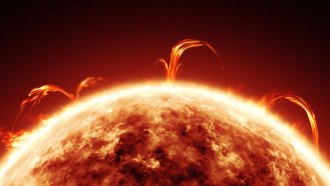
Nuclear fusion is the physics that powers the sun and could someday provide abundant clean energy on Earth.
- Physics
Scientists Say: Fission
Nuclear fission is the process of splitting atoms apart to release huge amounts of energy.
- Computing
Scientists Say: Artificial intelligence
Artificial intelligence is technology smart enough to do tasks that would normally require human brainpower.
- Health & Medicine
Scientists Say: Infection
Infections range from mild illnesses, such as the common cold, to deadly diseases, such as rabies.
-
- Chemistry
Scientists Say: Fluorescence
This property causes materials — including some animals’ skin, fur or feathers — to glow under light.
- Brain
Scientists Say: Glymphatic System
The glymphatic system bathes the brain in cleansing fluids during sleep and clears away harmful cellular waste.
- Math
Scientists Say: Mean, median and mode
Mean, median and mode are all different ways to describe the middle value in a dataset.
-
- Physics
Scientists Say: Neutron
Neutrons are one of the main building blocks of atoms and have no electric charge.