Questions for ‘Fractals describe patterns hidden all around us’ 
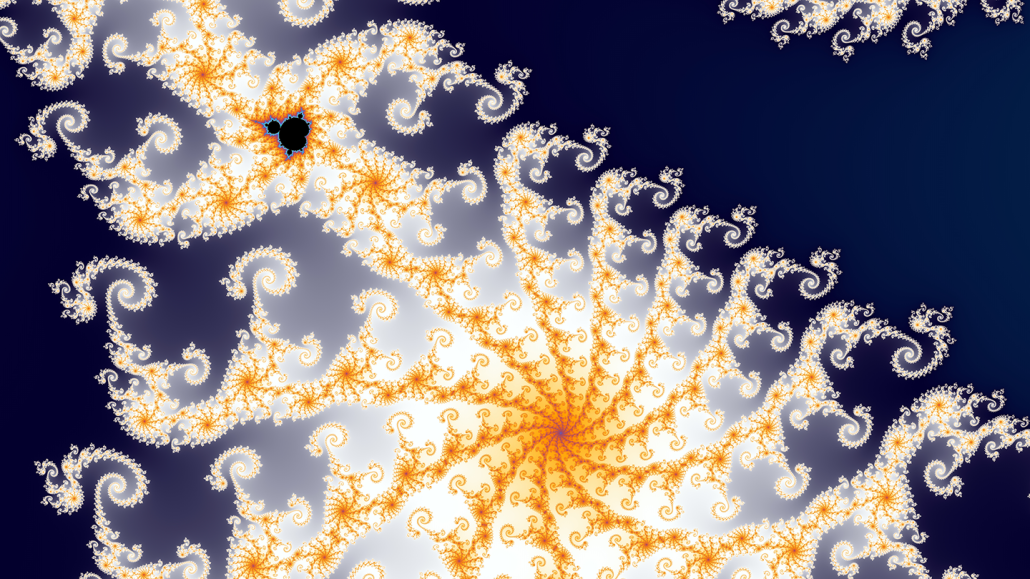
a white and yellow spiraling fractal pattern on a dark blue background

The outermost shapes here almost look like seahorses. If you zoom in on them, you’ll see more, smaller seahorses. Zoom in on those, and you’ll find even more seahorses. It’s seahorses all the way down. A shape where the same pattern repeats no matter how close you get is called a fractal.

Michael Piepgras/iStock/Getty Images Plus

To accompany Fractals describe patterns hidden all around us

SCIENCE

Before Reading:

  1. Sketch a square. Then use straight lines to break the large square into four smaller ones. Finally, draw more lines to break those small squares into yet smaller ones. How many times do you think you could theoretically continue this process of breaking large shapes into smaller ones? Explain your answer.
  2. What is a pattern? Look around the room and find one example of visual pattern. Come up with a one-sentence definition of a pattern in your own words.

During Reading:

  1. How does a fractal differ from other kinds of visual patterns? Use the concept of self-similarity in your answer.
  2. What is the name of the mathematician who coined the term fractal?
  3. From what Latin word does “fractal” originate? What does this Latin word mean?
  4. In one sentence, explain why a snowflake is an example of a fractal-like pattern.
  5. Explain why a straight line is “one-dimensional” in math.
  6. What is a term for a quantity measured in three dimensions?
  7. Give two examples of fractal-like patterns that can be found in our bodies.
  8. Give an example of a musician who used fractal-like patterns in composing music.
  9. What is chaos theory?
  10. How did Michael Barnsley’s recognition of fractal-like patterns in images lead to advances in computer science?

After Reading:

  1. Review your answer to Question #1 in Before Reading. Create another fractal shape similar to the fractal squares, but using triangles. Start by drawing a single large triangle on a blank sheet of paper. Then break it up into smaller ones. (Hint: Start by dividing your large triangle with a horizontal line across the middle. Then build from there.) Use markers or colored pencils to turn your fractal into a piece of art. Write a one-sentence explanation of how your art is an example of a fractal-like pattern.
  2. Describe how fractal-like patterns might appear in one of the following fields: urban design, architecture or economics. Come up with an example — not one from this story — of how fractals might occur in this field. Explain one benefit of using fractals for this application.