Matter and Its Interactions
- Chemistry
Structures that work like Hermione’s magic handbag land a chemistry Nobel
Richard Robson, Susumu Kitagawa and Omar Yaghi developed these metal-organic frameworks, which can trap pollutants, collect water from air and more.
- Archaeology
Knotted strands of 500-year-old hair tell a surprising story
Used in a device called a khipu, the hair reveals the owner’s simple diet. Those data now suggest that in Incan society, even some commoners kept records.
- Physics
Could we ever build the tech to shrink ourselves?
The atoms that make us up couldn’t be shrunk or smashed closer together — at least, not without catastrophic consequences.
- Chemistry
Scientists Say: Element
The number of neutrons and electrons can vary in atoms of the same element. The number of protons alone sets each of these substances apart.
- Chemistry
Newfound ‘anti-spice’ compounds tame chili peppers’ heat
Five compounds make some chili peppers taste less spicy than others. Scientists are still figuring out why.
- Physics
Scientists Say: Tauonium
No protons, neutrons or electrons. And yet, based on what scientists know about fundamental particles, this variety of atom just might exist.
- Chemistry
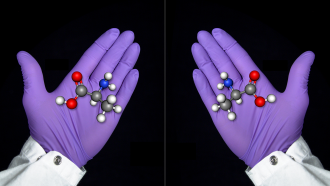
Scientists Say: Chiral
Many biological molecules come in a left- and right-handed form — and biology plays favorites.
- Chemistry
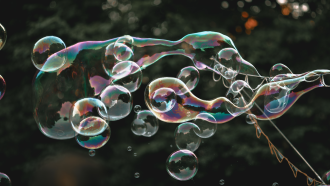
Experiment: Blow the best homemade bubbles
What’s the best recipe for blowing the most impressive bubbles? Let’s find out.
- Chemistry
A new map of Africa sheds light on the origins of enslaved people
Mapping the element strontium across the continent is helping track down the birthplaces of enslaved Africans brought to the Americas.
- Physics
Scientists Say: Lepton
Leptons are a quirky class of particles. Besides electrons, they include ghostly neutrinos and hefty muons and tauons.
- Earth
Let’s learn about the carbon cycle
The total amount of carbon on Earth doesn’t change. But what form those carbon atoms take is constantly changing.
- Physics
This weird ice may exist on alien planets
Scientists used high pressure and heat to create plastic ice, which has qualities of both ordinary ice and liquid water.