Matter and Its Interactions
- Math
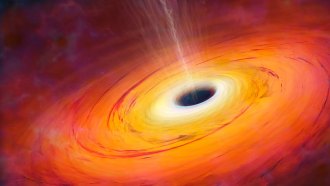
Scientists Say: Dimension
The simple concept of dimensions has inspired sci-fi creators to wrinkle time and launch into hyperspace.
- Math
His love of math led to a career in quantum computing
James Whitfield began his career when quantum computing was still in its infancy. Today, he’s helping to make it more accessible to educators, researchers and others.
- Chemistry
Let’s learn about chocolate
Humans have been making chocolate for millennia. Now scientists are investigating how to make this tasty treat more abundant and nutritious.
- Chemistry
Behold the world’s thinnest pasta
Made from white flour and formic acid, the nanofibers average just 370 nanometers across. That’s two-hundredths the thickness of a human hair.
- Chemistry
Experiment: How to keep fruit slices fresh
Let’s explore why fruit tends to brown over time and how to keep it looking fresh.
- Archaeology
Let’s learn about radiocarbon dating
Through the power of radioactivity, carbon dating can reveal the age of many fossils and artifacts.
- Chemistry
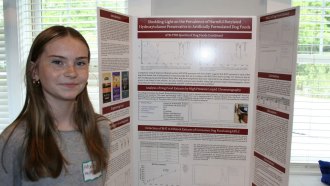
Teen chemist uncovers potentially harmful preservatives in pet food
Thermo Fisher JIC finalist Mackensey Wilson measured levels of a chemical called BHT in three pet food brands.
- Chemistry
Scientists Say: Rocket propellants
Rockets need more than fuel to get where they need to go — they also need oxidizers to burn that fuel. Together, these chemical combos are known as rocket propellants.
- Chemistry
Experiment: What makes ice melt fastest?
During the winter, you might have seen trucks spreading a mix of salt and sand on the roads to de-ice them. But how does that work? Let’s investigate.
- Materials Science
Scientists Say: Quantum dot
Quantum dots are nanosized specks whose properties are governed by the strange rules of quantum physics.
- Physics
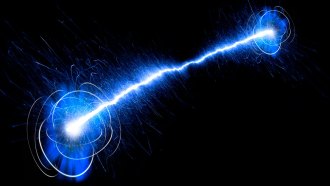
Let’s learn about entanglement
Entanglement is a special connection between particles that syncs up their properties — even when the particles are far apart.
- Chemistry
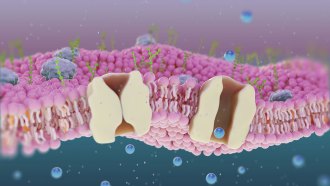
Explainer: How cells use chemistry to make the electricity of life
Charged particles, or ions, constantly move in and out of cells. These migrations produce tiny electric currents, which power your brain, heart and more.