Physics
- Physics
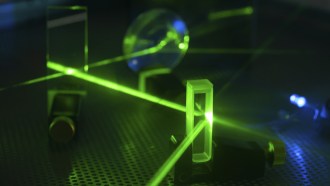
Efforts to create ultrafast light pulses win 2023 physics Nobel
Pierre Agostini, Ferenc Krausz and Anne L’Huillier won the prize for creating light bursts that last billionths of a billionth of a second.
- Chemistry
Scientists Say: Rare earth element
Rare earth elements aren’t all that rare — but skyrocketing demand for these metals makes them precious.
- Physics
Scientists Say: X-ray
X-rays are a type of light that doctors use to image the inside of the body. Astronomers use X-rays to explore the cosmos.
- Animals
Analyze This: White wing spots may help monarch butterflies fly far
Monarchs with more white on their wings are more successful migrants, new research shows
- Materials Science
Made from fungi, this vegan leather can self-heal holes or rips
If made under gentle conditions, leather formed from the “roots” of mushrooms can retain the ability to regrow and repair minor damage.
- Tech
Gravity ‘batteries’ might help a weighty renewable-energy problem
To store the energy generated by wind and solar power, researchers are looking at mammoth systems that raise and lower weights.
- Space
Experiment: A puzzling parallax helps stargazers
In this project, we explore how perspective, or parallax, can be used to measure the distances to objects such as stars.
- Physics
Scientists Say: Radio Waves
Lightning, stars, supermassive black holes and more give off radio waves.
- Tech
New thermal ‘cloak’ keeps spaces from getting too hot or too cold
A prototype fabric could help keep cars, buildings and other spaces cooler during heat waves while also reducing greenhouse-gas emissions.
- Chemistry
Scientists Say: Valence electrons
These far-out electrons do the hard work when it comes to chemical reactions.
- Space
Ghost particles paint a new picture of the Milky Way
Scientists tracked neutrinos from space to create a new map of our galaxy. It’s the first image of the Milky Way to be made without light.
- Space
Newfound gravitational waves may be from the biggest black holes in the universe
Observations of dead stars hint that ripples in spacetime — ripples light-years long — roll through our universe.