Physics
- Physics
Heat makes water evaporate. Now it appears light can, too
In the lab, shining light on water made it evaporate faster. This never-before-seen effect, if real, might be happening naturally all around us.
- Physics
A new tool shows tiny changes in the ’24-hour’ length of a day
An underground instrument known as ‘G’ uses laser beams to measure Earth’s rotation — a gauge of day length — with extreme precision.
- Tech
Particles from tree waste could prevent fogged lenses, windshields
A new coating made from a renewable resource — water-loving nanoparticles made from wood — could keep glass surfaces fog-free.
- Physics
Experiment: How well do different materials create static electricity?
Why are some materials more susceptible to static cling than others? Investigate by making your own electroscope.
- Physics
Scientists Say: Gamma ray
Lightning bolts, nuclear explosions, colliding stars and black holes all throw off this high-energy type of light.
- Materials Science
A new hydrogel could help pull drinking water from the air
The salty gel absorbs more water from the air than similar gels, even in desert climates. This could provide clean water for drinking or farming.
- Physics
Scientists Say: Ultrasonic
This word describes sound waves that have frequencies too high for human ears to hear.
- Physics
Skipping stone physics could aid net-tangled whales and more
The unexpected movement of buoys and spheres in water could lead to redesigns for fishing nets and ships.
- Animals
Where does Godzilla get his atomic breath?
Some secrets of the kaiju’s atomic breath can be explained with creative applications of physics and biology.
- Physics
Scientists Say: Supercool
When a liquid is supercooled, it has been chilled below its freezing point without freezing.
- Chemistry
Creation of quantum dots wins 2023 chemistry Nobel
The award honors three scientists who discovered and built quantum dots, which are now used in everything from TVs to medical tools.
- Physics
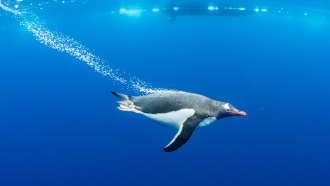
‘Feathering’ helps explain Gentoos’ record-breaking swim speed
Videos and computer analyses reveal the secrets of the penguins’ superspeed. The results could inspire future underwater vehicles.