All Stories
- Agriculture
Let’s learn about eating bugs
Eating more insects, rather than pork, beef or other kinds of meat, may be better for the planet.
- Earth
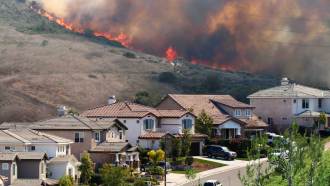
Analyze This: Wildfires are pumping more pollution into U.S. skies
Researchers wanted to study the health effects of wildfire smoke. But they realized they didn’t know where it was and how much exposure people had.
- Brain
Scientists Say: Glymphatic System
The glymphatic system bathes the brain in cleansing fluids during sleep and clears away harmful cellular waste.
- Physics
Protons may be stretchier than physicists had thought
Physicists looked at how the quarks that make up protons move in response to electric fields. And they found more movement than expected.
- Animals
Insect swarms might electrify the air as much as storm clouds do
Honeybees that flew over a voltage sensor sparked a new look at the effect of insects on electricity in the atmosphere.
- Chemistry
Explainer: What is a hydrogel?
These unusual materials have a host of unusual properties. You can even make a starch-infused version in your kitchen.
- Math
Scientists Say: Mean, median and mode
Mean, median and mode are all different ways to describe the middle value in a dataset.
- Environment
‘Forever’ chemicals show up in students’ school uniforms
Researchers found PFAS “forever chemicals” in kids’ school uniforms and other clothing. Studies have linked these compounds to health risks.
- Animals
If mosquitoes vanished, would we miss them? Vampire spiders might
Vampire spiders get their meals from blood-filled Anopheles mosquitoes. But if those insects disappear, the spiders will likely adapt.
- Health & Medicine
Should we use a genetic weapon against mosquitoes carrying malaria?
One gene drive to eliminate malaria seems to work in the lab. Now it’s time to ask local people if they want it released in the wild.
- Animals
Some seabirds survive typhoons by flying into them
Some birds take massive detours to avoid cyclones. But shearwaters caught between land and the storm’s eye sometimes fly toward the storm’s center.
- Materials Science
Let’s learn about microplastics
Microplastics have turned up everywhere from the highest mountains to the bottom of the ocean — and even inside animals and people.