angle: The space (usually measured in degrees) between two intersecting lines or surfaces at or close to the point where they meet.
atmosphere: The envelope of gases surrounding Earth, another planet or a moon.
disk: A round, flat and usually fairly thin object.
drag: A slowing force exerted by air or other fluid surrounding a moving object. It involves friction. But unlike simple friction, it increases with an object’s speed.
drone: A remote-controlled, pilotless aircraft or missile.
engineer: A person who uses science and math to solve problems. As a verb, to engineer means to design a device, material or process that will solve some problem or unmet need.
fabric: Any flexible material that is woven, knitted or can be fused into a sheet by heat or compression and drying.
football field: The field on which athletes play American football. Owing to its size and familiarity, many people use this field as a measure of how big something is. A regulation field (including its end zones) runs 360 feet (almost 110 meters) long and 160 feet (almost 49 meters) wide.
force: Some outside influence that can change the motion of an object, hold objects close to one another, or produce motion or stress in a stationary object.
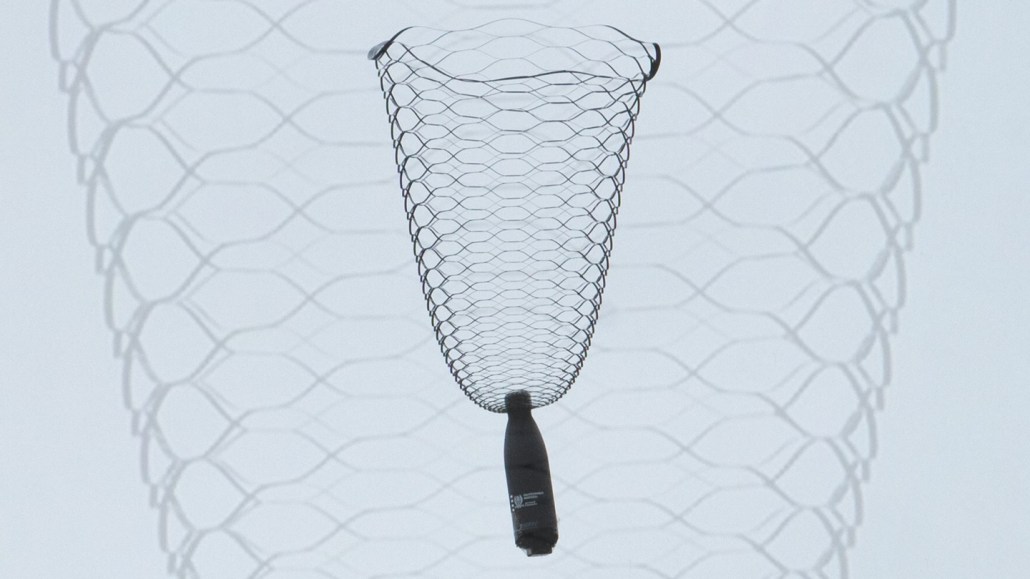
kirigami: A type of Japanese art that (like origami) involves the folding of paper or some other material into ornamental objects or designs. What makes kirigami different is that it also involves making cuts that will affect the object’s design as it folds or bends.
mechanical engineer: Someone trained in a research field that uses physics to study motion and the properties of materials to design, build and/or test devices.
planet: A large celestial object that orbits a star but unlike a star does not generate any visible light.
plastic: Any of a series of materials that are easily deformable; or synthetic materials that have been made from polymers (long strings of some building-block molecule) that tend to be lightweight, inexpensive and resistant to degradation. (adj.) A material that is able to adapt by changing shape or possibly even changing its function.
radius: (plural: radii) A straight line from the center to the circumference of a circle or sphere. (in physiology) The smaller of two bones in the forearm (the other is the ulna) running between the wrist and the elbow.