HS-LS2-2
Use mathematical representations to support and revise explanations based on evidence about factors affecting biodiversity and populations in ecosystems of different scales.
- Health & Medicine
By the numbers: How infectious measles and other diseases spread
A number called R0 measures how contagious an infectious disease is. It helps explain why measles is so dangerous.
- Life
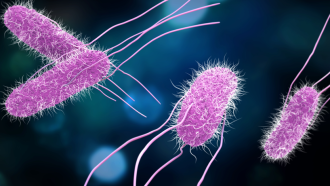
Explainer: Prokaryotes and Eukaryotes
Prokaryotes tend to be small and simple, while eukaryotes have embraced a highly organized lifestyle. These divergent approaches to life have both proved very successful.
- Animals
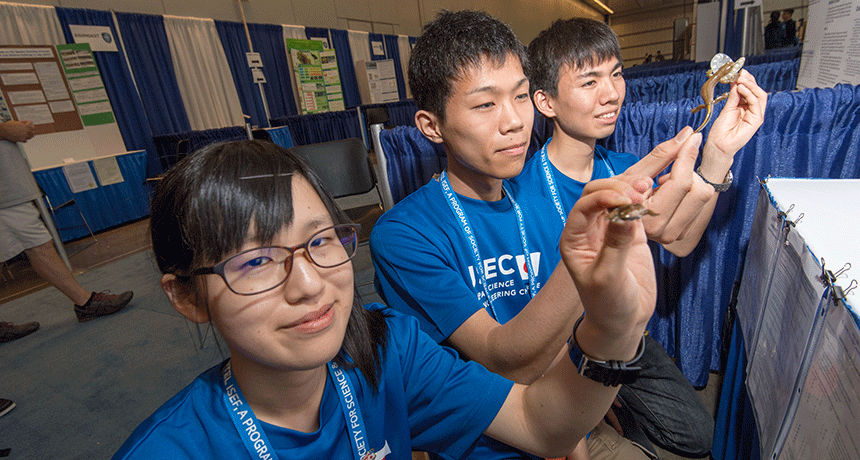
Hunting hidden salamanders with eDNA
The Japanese clouded salamander is an elusive beast. To find a new population, three teens turned to high-tech methods.
- Animals
‘Boot camp’ teaches rare animals how to go wild
Animals raised in captivity cannot safely re-enter the wilds without first understanding how to find food and avoid becoming a predator’s lunch. Scientists are helping some species learn this.
- Health & Medicine
Scientists discover how norovirus hijacks the gut
Noroviruses make people vomit, but scientists didn’t actually know why. It now turns out that those viruses cause their misery by attacking special “tuft” cells in the gut.
- Animals
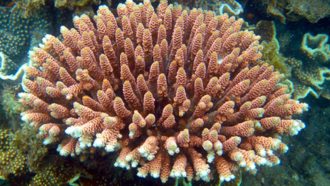
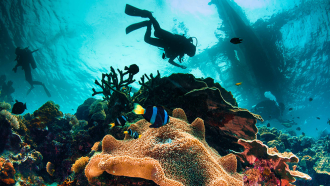
Ocean heat waves are on the rise — and killing coral
Ocean heat waves are becoming hotter and more frequent. And one can be blamed for the 2016 coral deaths on the Great Barrier Reef.
- Health & Medicine
Which bacteria hang out in belly buttons? Here’s a who’s who
Bacteria are everywhere — even in our belly buttons. One teen at Intel ISEF decided to find out what types people were harboring in their navels.
- Animals
In a colony, king penguins act like a liquid
Is this a living liquid? King penguins move around within their colonies, clearing out some space, and then refilling it. That behavior resembles a liquid, scientists conclude.
- Animals
Fighting ‘like an animal’ may not be what you expect
Evolution has produced a broad range of conflict styles. And some of the best examples come from outside the world of the familiar.
- Animals
Cool Jobs: Diving for new medicines
Scientists mix research with underwater adventure as they search the oceans for new chemicals to treat infections, cancer and more.
- Health & Medicine
Analyze This: Flu vaccine’s protection varies
Getting a flu shot every year is an important way to protect yourself and those around you — even if the vaccine isn’t 100 percent effective.
- Agriculture
Explainer: The fertilizing power of N and P
Two elements — nitrogen and phosphorus — help plants grow. When the soil doesn’t have them, farmers might add them in the form of fertilizer.