Physics
Trying to break a photon would create a quantum mess
Attempting to cut a light particle in half would spawn up to infinite new photons, a new model shows.
Used in a device called a khipu, the hair reveals the owner’s simple diet. Those data now suggest that in Incan society, even some commoners kept records.
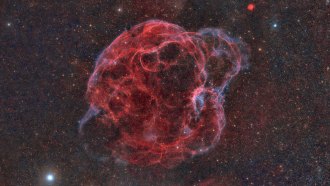
For this nuclei-forging cosmic process, the Big Bang was just a way to get started.
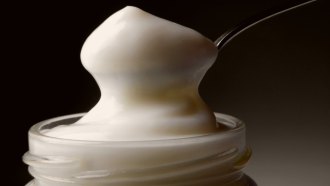
Yes, mayo. The texture of the sandwich spread is perfect for mimicking what a fusion fuel capsule goes through when blasted with lasers.
The grave holds a sword. It hints the buried woman fought or helped plan raids some 2,000 years ago in what’s now southwest England.
The sun creates energy through nuclear fusion. Now scientists have too. This achievement raises hopes for developing a new type of clean energy.
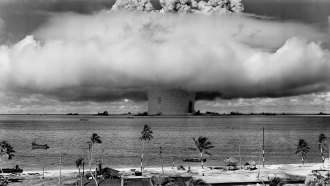
Nuclear fission is the process of splitting atoms apart to release huge amounts of energy.
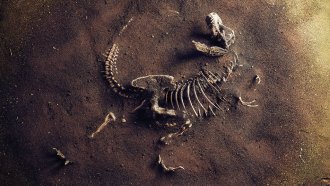
Knowing the decay rate of radioactive elements can help date ancient fossils and other artifacts.
Like clockwork, radioactive forms of some elements shed parts of themselves as they attempt to become nonradioactive.
Neutrons are one of the main building blocks of atoms and have no electric charge.