Physics
- Materials Science
‘Stenciling’ tiny gold particles gives them new properties
Decorating nanoparticles with other chemicals could give them useful properties for medicines, textiles and more.
- Fossils
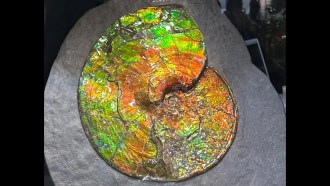
Here’s why ammolite gems have a rainbow shimmer
The fossils’ fabulous colors arise from delicate assemblies of crystal plates.
- Space
This cosmologist studies the invisible parts of the universe
Katie Mack started out building solar-powered LEGO cars as a kid. Now she studies dark matter to better understand how galaxies form and evolve.
- Physics
Chopping an onion? Sharp knives can keep its juice out of your eyes
Slow and steady cuts with a sharp blade, video shows, can reduce the pain-inducing spray of tiny onion-juice droplets.
- Chemistry
Scientists finally know why ice is so slippery
It’s not because ice heats up and then partially melts. Rather, ice changes at the molecular level — a process scientists have finally modeled.
- Materials Science
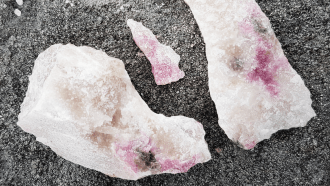
Scientists Say: Tenebrescence
Under ultraviolet light, some minerals adopt long-lasting new hues.
- Tech
Origami folds let paper support 9,000 times its weight, teen finds
Miles Wu, 14, tested the strength of different ‘Miura-Ori’ origami folds and showed they might be useful in the design of pop-up emergency shelters.
- Physics
Here’s how to levitate something without magic
Levitation may seem like fantasy. But all it takes is a little physics — and sound waves, magnetism or electricity.
- Animals
Rudolph’s red nose could glow through bioluminescence
Simple chemistry could give the reindeer his iconic red snout. But physics would make it look different colors to anyone who spied Rudolph from the ground.
- Physics
These parachutes unfurl thanks to Japanese paper-cutting techniques
Parachutes inspired by Japanese kirigami are full of holes. When dropped, they open automatically and fall more predictably than standard parachutes.
- Earth
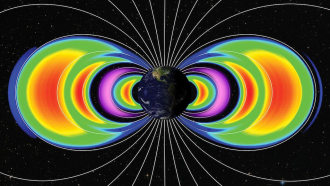
Scientists Say: Van Allen belts
Astronomers have detected these radiation belts around Earth and beyond. Jupiter’s belt is thousands of times as intense as Earth’s.
- Physics
Why are skis so long?
Let’s strap skis to an action figure to see how long sticks of wood help people glide gracefully over snow.