Tech
- Tech
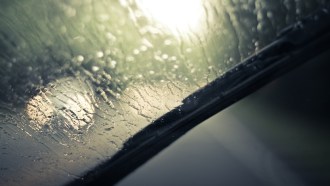
Teens want to make windshield wipers obsolete
Windshield wipers often can’t keep up with the rain. High-intensity air sprays might one day take their place, according to research by two teens.
- Health & Medicine
Teens win big for pollution control and HIV detection
Ah-choo! The 2015 Intel ISEF competition’s top winner designed a way to curb germs on planes. Two other big winners invented ways to detect HIV early and to corral oil spills at sea.
- Tech
Stepping out with a smarter cane
Many older people trip and fall on uneven ground. A Colorado teen has designed a ‘smart’ cane to help seniors avoid dangerous obstacles.
- Tech
Making cents of sounds
Some people give up when a vending machine rejects their money. But one student decided to turn his frustration into inspiration. Through research, he showed how to identify coins by the sounds they make.
- Health & Medicine
Bones: Custom cushioning helps heal a bad break
If the stiff casts encasing broken limbs included an inflatable air bladder instead of a soft lining, costly and painful complications experienced by some patients during healing might be avoided, two teens reported at the 2015 Intel ISEF competition.
- Brain
Hands-free but still distracted
When people aren’t distracted, they can see a traffic light change very quickly. But a teen scientist now shows that texting — even with a hands-free device — gets dangerously slow.
- Animals
What’s the buzz? A new mosquito lure
Broadcasting a fake buzz can lure male Aedes aegypti mosquitoes away from females. That could reduce populations of these annoying — and disease-causing — insects, reports a teen at the 2015 Intel ISEF competition.
- Archaeology
Laser vision reveals hidden worlds
From discovering ancient ruins to forecasting climate change, the laser mapping technology called lidar is changing many fields of science.
- Tech
Explainer: What are lidar, radar and sonar?
Radar, sonar and lidar and are three similar technologies. Each relies on the echoing of waves — radio, sound or light waves — to detect objects.
- Materials Science
Cool Jobs: Big future for super small science
Scientists using nanotechnology grow super-small but very useful tubes with walls no more than a few carbon atoms thick. Find out why as we meet three scientists behind this huge new movement in nanoscience.
- Physics
News Brief: As timely as it gets
A newly modified atomic clock won’t lose or gain a second for 15 billion years. This timepiece is about three times more precise than an earlier version.
- Earth
Fracking wastes may be toxic, tests show
Fracking operations have been polluting the environment. Some wastes have hormonal effects. Studies in mice now show that prenatal exposures to these wastes can trigger subtle but disturbing organ impacts.