All Stories
- Tech
New technologies could keep people cool in a warming world
New approaches to air conditioning aim to keep people cool with fewer greenhouse-gas emissions as our world warms.
- Health & Medicine
Hand dryers can infect clean hands with bathroom germs
Hot-air hand dryers are a haven for microbes. A finalist at Regeneron ISEF found that these machines spray germs all over freshly washed hands.
- Animals
How to tell if cats are having fun — or if fur is flying
Quietly wrestling cats may be hard at play. But if they’re chasing and yowling, you might have a cat fight on your hands.
- Chemistry
This forensic scientist is taking crime science out of the lab
Kelly Knight uses her past struggles and passion for forensics to inspire her students.
- Microbes
Scientists Say: Virus
A virus must take over a living cell's machinery to make more viruses.
- Chemistry
Experiment: Keep your candy cool with the power of evaporation!
In this science project, use the energy produced when water evaporates to cool down chocolate-covered candy so it doesn't melt.
- Health & Medicine
Fentanyl deaths have spiked among U.S. kids and teens. Here’s what to know
A pediatrician discusses how teens can protect themselves and their friends from this extremely deadly drug.
- Fossils
Ocean life may have bounced back after the ‘Great Dying’
Marine ecosystems may have been back in action just a million years after the most severe extinction event known.
- Humans
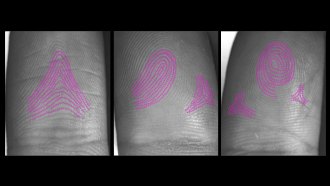
How fingerprints form is no longer a mystery
A mathematical theory proposed in the 1950s helps explain how fingerprint patterns such as arches, loops and whorls arise.
- Ecosystems
Let’s learn about how wildfires keep ecosystems healthy
Wildfires are so important for many ecosystems that sometimes professionals set them on purpose.
- Chemistry
Scientists Say: PFAS
Non-stick coatings, stain-resistant cloth and other common materials leach long-lived PFAS into soil and water.
- Climate
Due to global warming, major league hitters are slugging more home runs
Major League Baseball has seen an average of 58 more home runs each season since 2010. The apparent reason: reduced friction on the balls in warmer air.